Security Rough-In Before Walls Close: What Should You Check?
Security rough-in before walls close on a data centre: the box, cable, door frame, firestop and record checks a GC or electrical contractor should make.
Key points
- Before close-in, every security device needs a box or backing, a pathway to its panel, and cable already pulled, labelled and tested.
- Hold one walk per area with the electrical foreman, security lead, superintendent, door hardware supplier and firestopping trade before drywall is booked.
- In Toronto, fire separations and firestopping are inspected before finishes and ceiling tiles, and anything covered before inspection has to be uncovered.
- Check every electrified door frame for conduit to its knockouts before the frame is grouted or the wall is boarded.
- Two Toronto university specs let devices move up to 3 m at no cost before installation, so settle locations before boxes go in.
You’re a few weeks from drywall on a data centre, and you need a clear list for the security rough-in before walls close and the ceiling grid goes up. The short answer covers five things, and all of them are cheap to fix while the studs are open. Every device needs a box or backing, a pathway, and cable that is pulled, labelled and tested.
Then check the door frames, the firestopping at every rated wall, and the drawing that records it all. The City of Toronto explains why in its inspection schedule for large buildings. Any element covered before it passes inspection “will have to be uncovered so they can be inspected.”
Inspections happen within two business days of your request. So the date that matters most is your own walk, set a few days ahead of the inspector.
What security rough-in has to be checked before walls and ceilings close?
Before walls and ceilings close on a data centre, check that every reader, camera, door contact, panel and network cabinet has a back box or backing. Each one needs a pathway back to its panel or network room, with cable pulled and labelled. Then check the door frames, the firestopping where cable crosses rated walls, and the conduit out to the yard and roof.
Owner standards in Toronto show what a consultant is likely to look for. Toronto Metropolitan University’s Division 28 standard asks for at least 1-inch conduit with a pull string from each single-cable outlet to the cable tray. It also allows no more than 100 feet or two 90-degree bends between pulling points.
The University of Toronto’s security specification caps conduit fill at 40%. It also wants at least 150 mm between boxes, so devices never sit back to back in the same wall.
Use this table on the walk, one room at a time.
| Area | Check before it’s covered | What a miss costs later |
|---|---|---|
| Card reader doors | Reader box on the latch side, conduit to each frame knockout, door contact and request-to-exit locations, cable pulled with slack | Cutting a finished wall or working on a rated frame |
| Cameras | Box or backing where the ceiling plan shows it, cable pulled, labelled and hung on its own supports | New holes and patching in a finished ceiling |
| Panels and network cabinets | Backing in the wall, 120 V circuit roughed in, conduit stubs to the ceiling | Opening the wall to add backing or a circuit |
| Rated walls | Sleeves sized for the cable, listed firestop in place and labelled | A failed fire separation inspection for the area |
| Yard and roof | Conduit, sleeves and pole bases in, roof penetrations agreed with the roofer | Trenching a finished yard or cutting a new roof penetration |
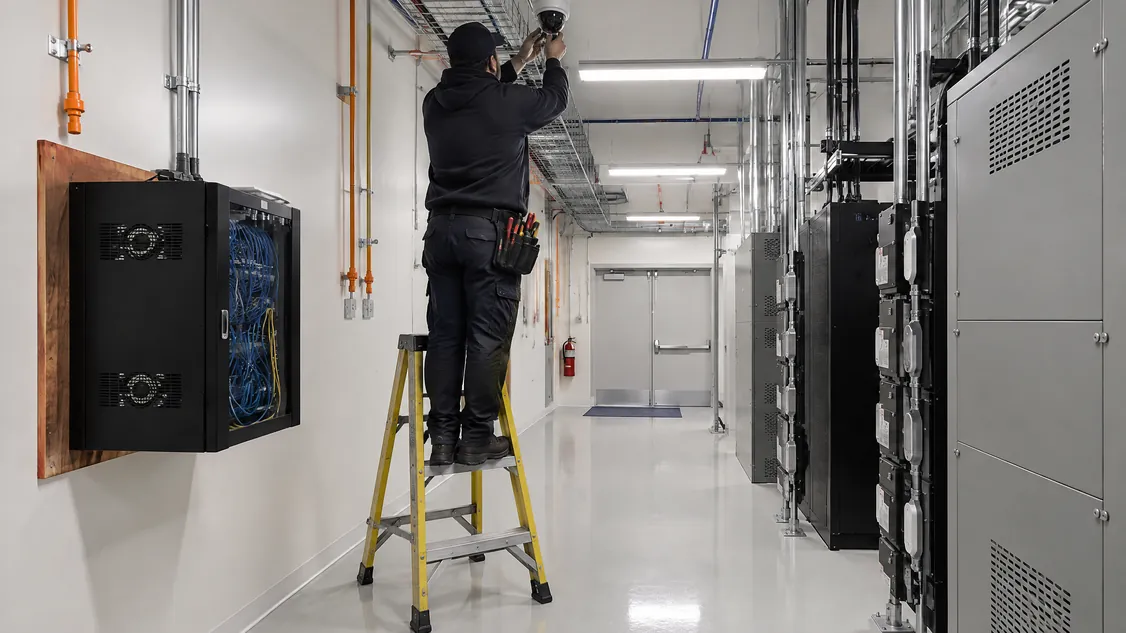
A wall-mounted network cabinet shows why the walk has to cover more than doors and cameras. Securitron installed one on a new Toronto data centre this year, and a cabinet like that typically needs backing in the wall, a power circuit and a pathway out.
Each of those is a small job before drywall and a messy one after.
When should the security close-in walk happen, and who should be there?
Hold the security close-in walk once rough-in in an area is done and before the drywall or ceiling crew is booked, leaving enough days to fix what you find. Bring the electrical foreman, the security sub’s lead hand, the GC’s superintendent, the door hardware supplier and the firestopping trade. One walk with all five beats five phone calls after the wall is closed.
Timing has a money side too, and two Toronto owner specs show it plainly. U of T lets a device move up to 3 m “at no extra cost or credit” if the information comes before installation. TMU allows the same 3 m “without any additional cost or change request.”
Once the box is in the wall, that free move is gone. The same change usually comes back to you as a change order.
On a data centre the walk usually splits by room, because data halls, electrical rooms and offices often close in on different dates and need their own walks. Our guide to when the security subcontractor should join a data centre project shows where this walk sits in the schedule.
What gets missed at card reader doors before close-in?
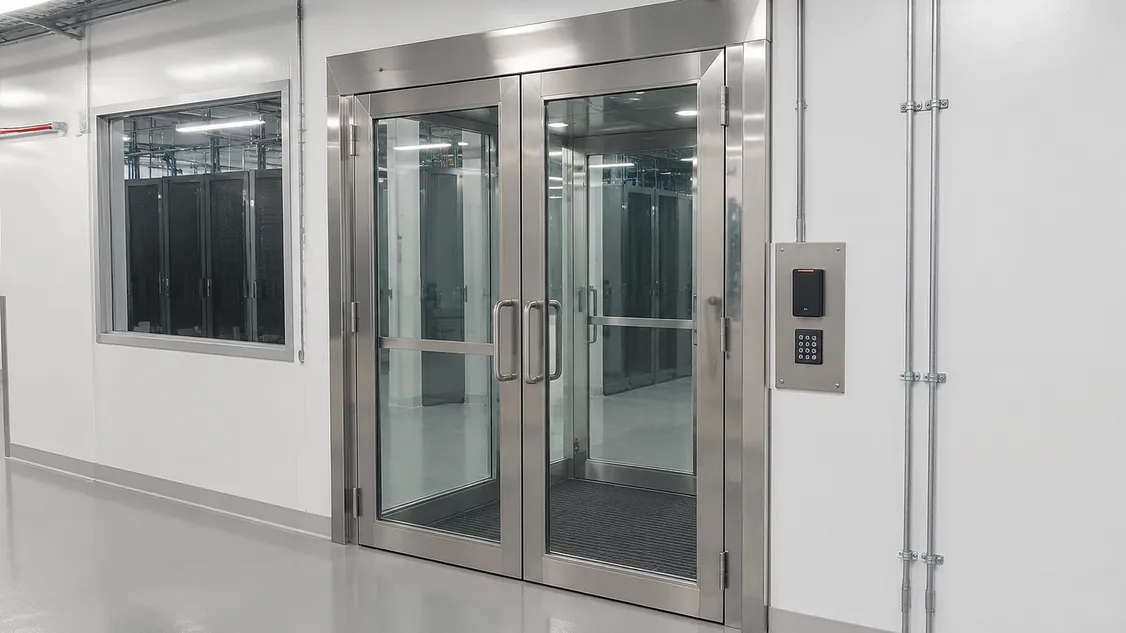
At card reader doors, the usual miss is the link between the wall and the frame. Electrified locks, door contacts and power transfer hinges need a cable path into the frame itself. Once the frame is grouted or the wall is boarded, getting cable in means cutting, so check every electrified opening against the approved hardware schedule one door at a time.
The National Association of Architectural Metal Manufacturers (NAAMM) covers this in its technical note on electrified hardware preparations. Frames with mortised electrified hardware get a steel grout guard with a 7/8-inch knockout at each end. For doors, pull wires or a wiring harness should be coordinated “prior to release for fabrication.”
Its optional junction box exists to give access to wire connections “prior to build-up of wall.” On the walk, confirm each knockout connects to conduit, that the conduit runs to the reader box and the panel, and that nothing has been grouted shut.
Surface-mounted electrified hardware needs a separate look from you. NAAMM notes those frames are only reinforced unless someone asked the frame maker for more before fabrication. Who supplies and wires each piece is covered in our electrified door hardware guide.
Why does firestopping belong on the security close-in walk?
Security cable often crosses rated walls around electrical rooms, battery rooms and network rooms. Every one of those openings has to be firestopped before the fire separation inspection. In Toronto that inspection comes before interior finishes and ceiling tiles, so one open security penetration can hold up a whole area, and a covered one may have to be opened again.
TMU’s firestopping standard for communications cabling puts the timing in one line. Firestopping is scheduled “after completion of penetrating item installation but prior to covering or concealing of openings.”
It also wants every firestop and its label in place before the engineer’s above-ceiling inspection. Each label names the manufacturer, the listed system number, the installer and the installation date.
Two questions at your next coordination meeting settle most of this risk. Who carries firestopping for security penetrations under your subcontracts? And is all the security cable through each sleeve before the seal goes in?
If more cable has to pass through later, the seal typically has to be opened and redone, which means one more trip and one more inspection item.
What record should come out of the close-in walk?
The walk should end with four records anyone on the job can use. The first is a marked-up drawing showing where each box, pathway and penetration went. The others are dated photos of every wall and ceiling before it closes, the cable test results, and a fix list with a name and date beside each item.
Those records feed the as-builts you’ll need at closeout, so nobody rebuilds them from memory months later. Our closeout guide shows how they keep holdback moving.
The U of T specification shows how far some owners take testing. It wants all wiring “checked and tested to insure there are no grounds, opens, or shorts” before termination. Results go in with the as-builts, and labels sit at each end of every run and at junction and pull boxes.
Testing cable while it’s still reachable can feel fussy, but a damaged cable found during programming has to be replaced through a finished wall or ceiling.
How do I get Securitron on the close-in walk?
Name Securitron as your security subcontractor at award, or add us to your bid list if the job is still in pricing. If you’re an electrical contractor carrying Division 28, bring us in as your security sub. Then the people pulling the cable are the same people standing on the walk with you.
Securitron has installed and serviced cameras, access control, intrusion alarms, intercom and structured cabling across the GTA since 2008. Our data centre page shows the kind of work involved.
Send us your drawings and rough-in dates, and we’ll mark up the close-in checks room by room before the drywall crew is booked.
Frequently Asked Questions
Toronto's inspection schedule for large buildings doesn't list security as its own inspection. It does inspect fire separations, closures and fire stopping before interior finishes and ceiling tiles, so security cable through rated walls gets looked at then. Life safety systems are inspected at rough-in with a referral to Toronto Fire Prevention, which can matter for doors that release on fire alarm.
Sometimes, if conduit with a pull string runs from each box to the ceiling or cable tray, which is why owner standards such as Toronto Metropolitan University's ask for it. Boxes, backing and door frame connections can't be added that way, so they still need checking before close-in. Pulling cable later can also mean reopening firestop seals at rated walls.
It depends on your subcontracts. If the device was on the issued-for-construction drawings, the trade that carried that rough-in usually owns the fix, and if it was added later it is normally a change order. A responsibility matrix attached to each subcontract settles this before anyone has to argue about it.
Securitron installs and services cameras, access control and alarms across the Greater Toronto Area and Hamilton, from our head office in Hamilton. That includes Toronto; Mississauga and Brampton in Peel; Vaughan, Markham and Richmond Hill in York Region; Oakville, Burlington and Milton in Halton; Pickering, Ajax, Whitby and Oshawa in Durham; and Hamilton, Guelph and Kitchener. For a job elsewhere in Ontario, call (905) 730-2425 to check.