Who Supplies and Wires Electrified Door Hardware on a Data Centre?
Who supplies, wires and tests electrified door hardware on a data centre, where it falls between trades, and a checklist to close the gaps.
Key points
- The door hardware supplier usually supplies electrified locks and power transfers, the electrician runs raceway and 120 V power, and the security sub programs and tests.
- Power supplies, door contacts and request-to-exit devices move between Division 08, 26 and 28 from one spec to the next, so confirm where each is listed.
- Hold one coordination meeting with door hardware, electrical and security before doors and frames are ordered.
- Name one trade to run the end-to-end test on every electrified opening, including fire alarm release on maglocks.
- A responsibility matrix for each opening type, attached to the subcontracts, stops items being bought twice or not at all.
If you’re carrying the security package on a data centre, edge site or server room, electrified door hardware is the item most likely to be bought twice or not at all. On most jobs the door hardware supplier (Division 08) supplies the electrified locks, strikes, exit devices and power transfers. The electrical contractor (Division 26) runs conduit, boxes and 120 V power, and the security sub (Division 28) supplies readers and controllers, then terminates, programs and tests. Every spec splits it a little differently, though.
The fix is simple: a responsibility matrix for each opening type, one coordination meeting before doors are ordered, and one named owner for the final test. This piece expands the door line from our Division 28 scope guide.
Who supplies electrified door hardware on a data centre?
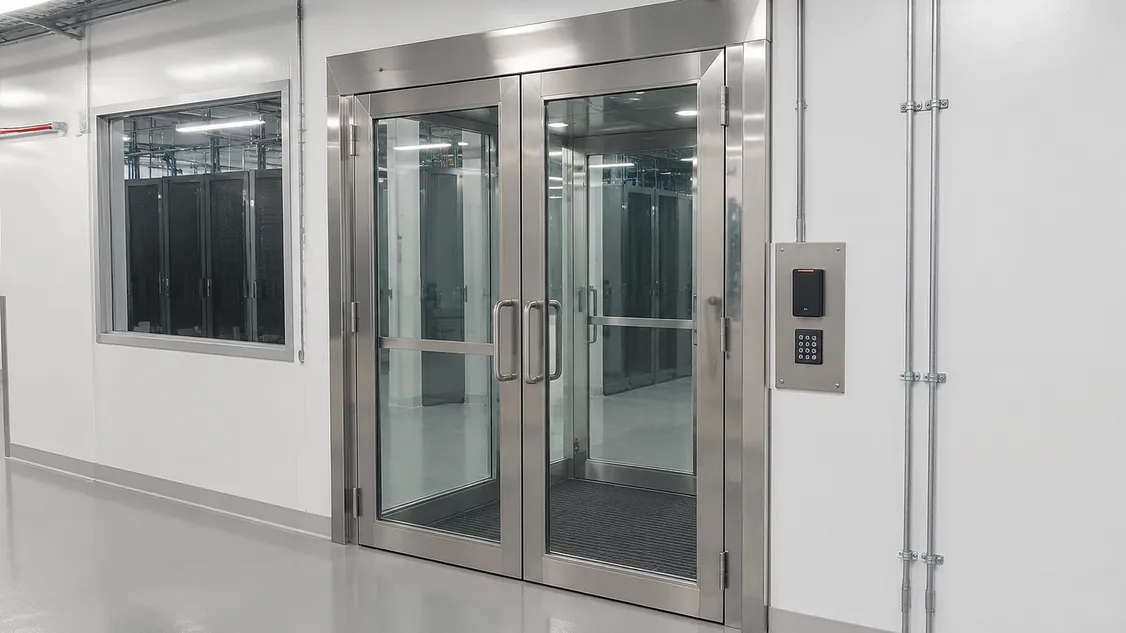
The door hardware supplier usually supplies the electrified hardware itself: electrified mortise locks, electric strikes, electrified exit devices, maglocks and power transfer hinges, all listed in the Division 08 hardware sets. The security sub supplies the access control side: readers, controllers and software. Power supplies, door contacts and request-to-exit devices are the items that move between sections from one spec to the next, so find where each one is listed before you price.
Two Canadian owner standards show how much the split varies. McGill University’s Division 08 hardware standard (October 2026) has the electrical contractor supply and install conduit, junction boxes, card readers and 120 V power, while the hardware section supplies, installs and connects electrified locks, exit devices, door contacts and maglocks. UBC’s door hardware guideline (November 2025) makes the Division 08 subcontractor responsible for hardware control panels, power supplies and low-voltage cable, unless the electrical drawings say otherwise.
Same items, two different homes. Treat the table below as a starting point and confirm each line against your spec.
| Item | Often supplied by | Often wired or connected by | Confirm before award |
|---|---|---|---|
| Electrified locks, strikes, exit devices, maglocks | Door hardware supplier (Division 08) | Division 08 installer or security sub | Which hardware set lists it, and who terminates it |
| Power transfer hinges, door and frame preps | Door hardware and door/frame suppliers | Door installer | Preps shown on shop drawings before ordering |
| Lock power supplies | Division 08 or security sub | Security sub or Division 08 | Mounting location, battery backup, circuit number |
| Raceway, back boxes, 120 V circuits | Electrical contractor (Division 26) | Electrical contractor | Every electrified opening on the electrical drawings |
| Card readers, controllers, software | Security sub (Division 28) | Security sub | Reader location on glass and double doors |
| Door contacts, request-to-exit | Division 08 or security sub | Security sub | Built into the lock, or separate devices |
| Fire alarm release on maglocks | Fire alarm contractor and security sub | Both, at the interface | Relay location and verification date |
Who wires electrified door hardware: the electrician, the door sub or the security sub?
Wiring splits into two halves. The electrical contractor typically carries raceway, back boxes and the 120 V circuit to each lock power supply. The low-voltage run from the lock, through the power transfer, to the power supply and on to the access control panel is where the gap usually hides, because it can sit in Division 08, 26 or 28. Name one trade for every conductor and put the security sub on the termination at the controller.
A planning guide from the Ohio Facilities Construction Commission states the common pattern plainly: “All raceway and 120V power to be by electrician” and “Low voltage wire from door to power supply to be by an integrator.” It also asks that there be “no question about who is responsible from Latch bolt to computer.”
Data centres raise the stakes. Data hall doors, security portals and cage doors often repeat the same opening type many times, so one missing power supply in a hardware set gets copied to every door of that type.
The door and frame need prep as well. UBC’s guideline specifies a 13 mm frame hole for the power transfer hinge and a cored wire chase in the door, “without affecting the door rating.” Fire ratings also limit the hardware choice: McGill does not permit electric strikes in fire-rated doors unless an automatic operator requires one, and calls for electrified mortise locks or exit devices where card readers go on rated doors. Ask how your spec handles rated openings before the hardware submittal is approved.
Who tests electrified door hardware, and when is the door done?
Each trade checks its own work, but a door is done only when it works as a whole. The lock releases on a valid card, the door contact and request-to-exit report correctly, held and forced alarms reach the panel, and any maglock releases on fire alarm. Name one trade to run that end-to-end test door by door. The security sub is the natural owner, because it programs the system that records the results.
Plan three layers of testing:
- Hardware function. The hardware installer confirms locking, latching and free egress.
- Access control function. The security sub tests every card read, contact, request-to-exit and alarm, door by door, and records the result.
- Fire alarm interface. The City of London’s maglock permit guide, written to the 2024 Ontario Building Code, requires installation and verification to CAN/ULC-S524-19 and CAN/ULC-S537-19 and an integrated systems testing coordinator form. Locks must stay released until conditions are restored and be “reactivated only by the operation of the authorized manual switch.” Toronto’s version is covered in the Division 28 guide.
The Ohio guide ends its construction checklist with a line every PM will recognise: “No one is done until it all works.” UBC also asks for a commissioning certificate “for the purpose of identifying the start of the warranty period,” which feeds straight into your closeout package.
Where does electrified door hardware fall between trades?
Gaps cluster in a few places: a power supply listed in no section, door and frame preps missed before ordering, a 120 V circuit missing from the electrical drawings, a fire alarm relay nobody carried, and hardware changed after the submittal was approved. Each is cheap to fix on paper. Once doors are hung and walls are closed, the same fix pulls back two or three trades and usually becomes a change order.
- Wiring diagrams. McGill requires an electrical diagram in the door hardware schedule for every door with a card reader, produced after the hardware shop drawings are accepted, to coordinate wiring between the general contractor and its subtrades. Ask for a riser and point-to-point diagram for each opening type.
- Dedicated circuits. UBC requires a dedicated circuit for every electrified opening, with the circuit number marked on the power supply and the as-builts.
- Ordering sequence. The Ohio guide calls for a meeting with “door hardware, electrical and tech contractor to review all doors prior to the doors being ordered.”
How do you stop electrified hardware falling between trades?
Run one coordination meeting, before door and frame submittals are approved, with the door hardware supplier, the electrical contractor, the security sub and the fire alarm contractor. Walk every opening type and leave with a one-page responsibility matrix attached to each subcontract. It costs an hour or two of everyone’s time, which is far less than reordering hardware or re-prepping doors after they arrive on site.
Use this list in the meeting:
- One supplier and one installer named for every item in the table above, by opening type.
- Power supplies: who supplies them, where they mount, battery backup, circuit number.
- Frame and door preps shown on shop drawings before release.
- A riser and point-to-point wiring diagram for each opening type, reviewed by the security sub.
- A sequence of operations for each door, including fail-safe or fail-secure and fire alarm release.
- Maglock interfaces shown on the fire alarm drawings, with a verification date booked after the security wiring is done.
- One end-to-end test owner and a signed test sheet for each door.
- Wiring diagrams and test records in the O&M manuals.
How do you bring Securitron in on the door hardware scope?
Securitron has installed and serviced access control, cameras, intrusion alarms and structured cabling across the GTA since 2008. Our data centre page shows the kind of work involved, and our access control page covers readers, locks and controllers.
If you’re pricing or buying out a data room, edge site or server room, add Securitron to your bid list or name us as the security sub. Send the door hardware schedule with the Division 08, 26 and 28 sections. We’ll mark up the responsibility matrix by opening type and review the hardware wiring diagrams with you before they’re approved.
Frequently Asked Questions
It depends on the spec. Some hardware sets list power supplies matched to the lock manufacturer in Division 08, and other specs put them in Division 28 with the access control panels. Find the line item before pricing, then name one supplier and one installer in your responsibility matrix, including where it mounts and whether it needs battery backup.
Expect fire alarm drawings, a sequence of operations and a fire alarm verification. The City of London's guide, for example, asks for fire alarm drawings sealed by an Ontario P.Eng., installation and verification to CAN/ULC-S524-19 and CAN/ULC-S537-19, and an installer and owner declaration form. Check your own municipality's forms early, because verification has to follow the security interface wiring.
Often yes, but it costs more. The frame may need a hole for a power transfer hinge and the door a wire chase, and field changes to a fire-rated door can raise questions with the inspector. Ordering doors and frames with the preps already in place is usually the cheaper route.
The security sub programs the access control system: schedules, access levels, held and forced alarms, and how each door behaves on fire alarm. The lock's own mode, such as fail-safe or fail-secure, is set by the hardware and has to match that sequence. Agree the sequence before the hardware is ordered.
Securitron installs and services cameras, access control and alarms across the Greater Toronto Area and Hamilton, from our head office in Hamilton. That includes Toronto; Mississauga and Brampton in Peel; Vaughan, Markham and Richmond Hill in York Region; Oakville, Burlington and Milton in Halton; Pickering, Ajax, Whitby and Oshawa in Durham; and Hamilton, Guelph and Kitchener. For a job elsewhere in Ontario, call (905) 730-2425 to check.