When Should the Security Subcontractor Join a Data Centre Project?
When should the security subcontractor join a data centre project? Before rough-in and the door hardware order. What each trade needs, and when.
Key points
- Bring the security subcontractor in at preconstruction or award, before the electrical rough-in drawings and the door hardware submittal are approved.
- Each trade needs one thing from security: layouts for the electrician, electrified openings for door hardware, port counts for IT, release points for fire alarm.
- Electrified doors that need alarm contacts are best prepped at the factory, so a late security decision adds lead time or rework.
- Under the Ontario Building Code, integrated fire and life safety systems are tested as a whole, and individual systems must pass their own tests first.
- Security programming depends on permanent power, live network ports and hung doors, so show those dates as dependencies on the schedule.
You have a data room, edge site or new data centre on the board, and you need to know when the security subcontractor should join the data centre project. Short answer: before the electrical rough-in drawings and the door hardware submittal are approved. On most jobs that means preconstruction, or right at award. If security joins later, the sub ends up chasing back boxes, door preps and switch ports that other trades have already built or ordered.
Below: what each trade needs from the security sub, when they need it, and what a late start costs.
When should the security subcontractor join a data centre project?
The security subcontractor should join at preconstruction or bid, and no later than award. That way shop drawings are approved before electrical rough-in starts and before the door hardware is ordered. The electrician builds the right back boxes and circuits, the door supplier preps electrified openings at the factory, and IT gets a port count before switches are bought.
A quick test: if the electrical rough-in drawings or the Division 08 hardware schedule go out for approval this month, the security sub should already be on the job. If both are already approved, hold a coordination review before anything else goes in. On design-build or fast-track work, bring security in while the design is still moving so it can price the scope and mark up layouts.
What does each trade need from the security sub, and when?
Each trade needs one deliverable from the security sub at a set point. The electrician needs device layouts and panel loads before rough-in. The door hardware supplier needs the list of electrified openings before its submittal. IT needs port and power counts before switches are ordered, and the fire alarm contractor needs release points before its shop drawings. When any one of these is missing, it usually comes back later as rework.
| Trade | What they need from the security sub | Needed by |
|---|---|---|
| Electrical contractor (Division 26) | Device locations, back box types, panel and power supply locations, circuit loads, conduit to exterior poles | Before rough-in drawings are approved |
| Door hardware supplier (Division 08) | Electrified openings, lock types, door contacts, request-to-exit devices, power transfers | Before the hardware submittal and door order |
| Fire alarm contractor | Doors that release on alarm, relay and interface locations | Before fire alarm shop drawings |
| IT or Division 27 cabling | Switch port count, PoE power budget (power over the network cable), cabinet space, IP address plan | Before switches are ordered |
| Framing, drywall and ceilings | Blocking for readers, cameras and wall-mounted cabinets | Before close-in |
| Site or civil contractor | Pole locations, bases, sleeves and conduit across the yard | Before the yard is graded and surfaced |
| Firestopping | Where security cable crosses rated walls and floors | Before firestopping in each area |
| Commissioning agent or owner | Device list, test plan, user and credential list | Before functional testing |
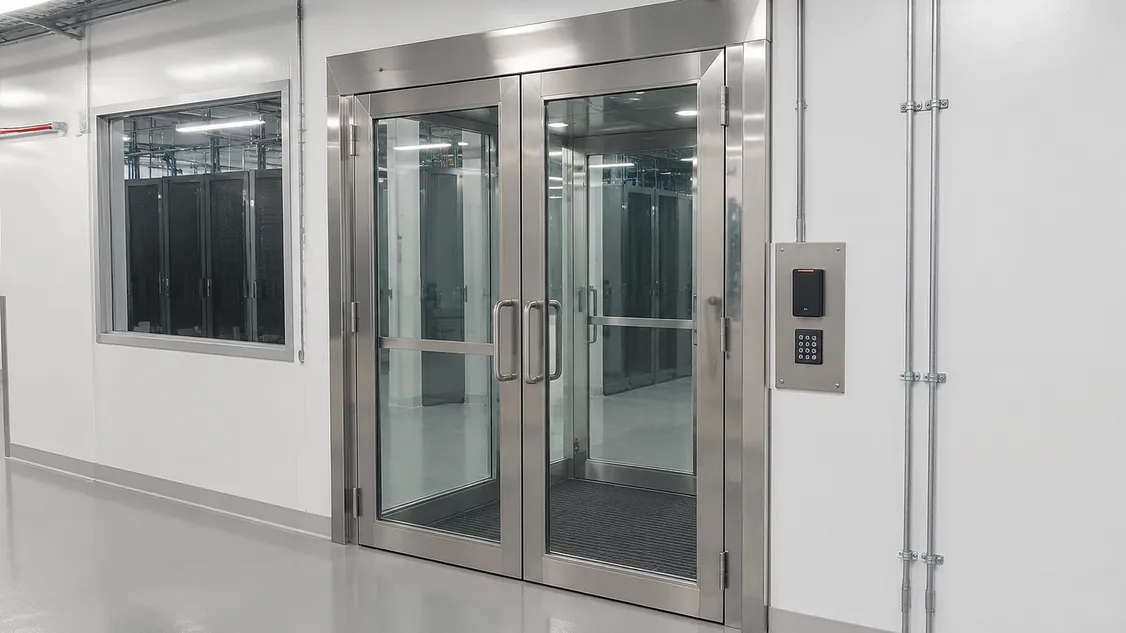
Doors set the tightest deadline. In its door hardware coordination guide, the US design firm TEECOM recommends that electrified hardware needing an alarm contact be incorporated at the factory: “If it’s done in the field it can ruin the door fire rating. This involves some lead time that should be built into the schedule.” If the doors were ordered without those preps, you are looking at field work or a reorder.
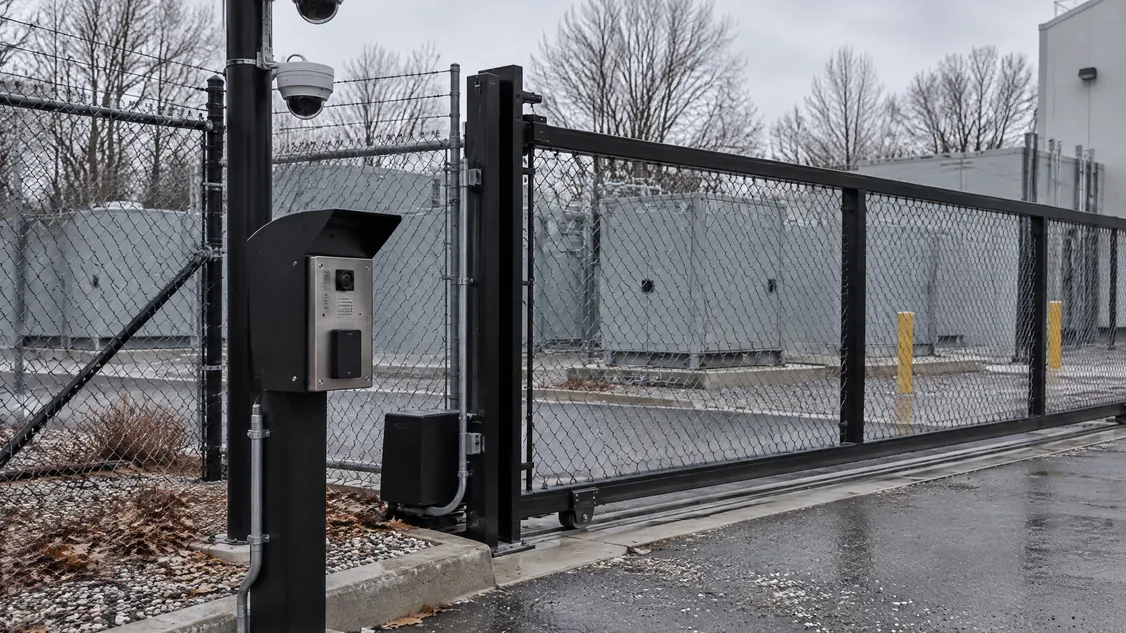
Exterior work has an early date too. On the Toronto data centre where Securitron installed security this year, dome cameras went on poles over the electrical switchgear yard. Pole bases and conduit across a yard like that typically need to be in before final grading and surfacing, well before any camera goes up.
What does the security scope look like stage by stage?
On most data centre builds, the security scope runs in six stages: preconstruction review, submittals and procurement, rough-in, close-in check, device installation, then programming and testing. The first two happen on paper, but they set every date that follows. The last two depend on other trades finishing first: permanent power, live network ports, and doors that are hung and adjusted.
- Preconstruction. Scope review against Divisions 08, 26, 27 and 28, RFIs on the gaps, and a price. Our Division 28 guide covers who carries what.
- Submittals and procurement. Shop drawings, product data and a procurement schedule for long-lead items.
- Rough-in. A joint walk with the electrician, boxes and conduit checked, and cable pulled while walls and ceilings are open.
- Close-in check. One walk before drywall to confirm every device has a box, blocking and a pathway.
- Devices and cabinets. Cameras, readers and panels typically go in once rooms are finished and can be locked.
- Programming, testing and turnover. Door-by-door and camera-by-camera tests, the integrated test where maglocks are involved, then closeout. Our closeout guide lists the package.
Does the security sub have a role during construction?
It can. A data centre under construction holds copper, switchgear and network gear before any permanent security is live. Temporary cameras over the perimeter and laydown areas, priced as their own line, cover that gap. The security sub can also log each networked device as it arrives, which feeds the asset list you need at closeout.
Data Center Knowledge argues that “the period of greatest exposure is often earlier: during construction.” It recommends “temporary but professional-grade surveillance cameras covering the perimeter, material laydown yards, and sensitive areas.” It also advises recording “serial numbers and MAC addresses of networked devices” on receipt. Settle who owns that log before the first delivery.
How does Ontario’s integrated testing rule affect the security schedule?
Under the Ontario Building Code, fire protection and life safety systems that are integrated with each other must be tested as a whole, and the report is needed for occupancy. Maglocks that release on fire alarm usually fall into that test. The security sub has to finish its own testing on those doors first, so security commissioning on those doors belongs on the critical path to occupancy.
The City of Barrie’s integrated system testing requirements, issued in March 2025, state that such systems “shall be tested as a whole in accordance with CAN/ULC-S1001,” as required by Article 3.2.9.1 of the Ontario Building Code. Its coordinator form lists electromagnetic locking devices among the systems to be integrated, and an integrated testing report is required for occupancy or to close the permit. Your municipality’s forms may differ, but the code article applies across Ontario.
The City of Ottawa’s advisory sets out the order. The standard “requires all initial testing, commissioning and verification of individual fire protection and life safety systems to be completed prior to the integrated systems testing.” (The advisory dates from 2023 and uses the older code numbering.) Date the security door tests ahead of the integrated test, and invite the security sub to the testing coordinator’s planning meeting.
What does a late security sub cost the project?
A late security sub mostly costs other trades’ time: cutting and patching finished walls, surface raceway where conduit was missed, field work on doors that should have come prepped, revised fire alarm drawings and a second test visit. Each of these becomes a change order. Several typically land in the last weeks before turnover, when the schedule has the least float.
Run these questions at your next coordination meeting:
- Are all security devices shown on the electrical rough-in drawings?
- Has the door hardware supplier seen the list of electrified openings?
- Does IT have the port count and power budget?
- Does the fire alarm contractor have every release point?
- Is security testing dated ahead of the integrated test?
- Do permanent power and network dates show as dependencies for programming?
How do I get Securitron on the schedule?
Add Securitron to your bid list at preconstruction, or name Securitron as the security sub at award. If you are an electrical contractor carrying Division 28, bring us in as your security sub. Either way, the earlier we see the drawings, the fewer dates other trades have to chase.
Securitron has installed and serviced cameras, access control, intrusion alarms, intercom and structured cabling across the GTA since 2008. Our data centre page shows the kind of work involved. Send us your drawings and baseline schedule, and we can mark up the security dates each trade needs before rough-in starts.
Frequently Asked Questions
Typically access control controllers, specialty or outdoor cameras, camera poles, and electrified door hardware that needs factory preparation. Lead times change by manufacturer and season, so ask the security sub for a procurement schedule with the first submittal and track it like any other long-lead package.
Not necessarily. The Ontario Building Code requirement applies to systems with fire protection and life safety functions that are integrated with each other, such as a maglock that releases on fire alarm. The designer and the integrated testing coordinator decide which doors are in the plan, so get that list early.
Procurement dates for long-lead items, rough-in, device and programming durations by area, and the dates it depends on from other trades, such as permanent power, live network ports and hung doors. Testing dates should sit ahead of the integrated test and the owner's commissioning.
Yes, and on fast-track jobs that is often when they help most. A sub brought in during design can price the scope, flag gaps between Divisions 08, 26, 27 and 28, and mark up device layouts before the electrical drawings are issued for construction.
Securitron installs and services cameras, access control and alarms across the Greater Toronto Area and Hamilton, from our head office in Hamilton. That includes Toronto; Mississauga and Brampton in Peel; Vaughan, Markham and Richmond Hill in York Region; Oakville, Burlington and Milton in Halton; Pickering, Ajax, Whitby and Oshawa in Durham; and Hamilton, Guelph and Kitchener. For a job elsewhere in Ontario, call (905) 730-2425 to check.