Division 28 on a Data Centre: What the Security Sub Carries
Division 28 on a data centre: what the security sub carries, what sits with electrical, doors and IT, and where scope gaps turn into change orders.
Key points
- Division 28, Electronic Safety and Security, is the MasterFormat division that covers access control, video surveillance and intrusion detection on a data centre.
- Security scope gaps usually sit at the edges: door hardware (Division 08), conduit and power (Division 26), and cabling and network (Division 27 and IT).
- Electrified locks are often specified in Division 08 but wired and programmed by the security sub, so each part needs a named supplier and installer.
- In Toronto, a maglock on an exit door needs fire alarm release, a signed installer's declaration and a fire alarm verification report.
- A one-page responsibility matrix attached to the subcontract settles who supplies, installs, wires and tests each item before it becomes a change order.
If you’re carrying the security package on a data room, an edge site or a new data centre, Division 28 on a data centre is the part of the spec that tells you what the security sub prices: access control, video surveillance and intrusion detection, plus programming, testing and closeout. Most of the trouble sits at the edges of that division, where door hardware, electrical, cabling, IT and fire alarm each assume someone else has the item.
This guide covers what the security sub usually carries, where the common gaps are, and a short check to run on bid day before you award.
What is Division 28 on a data centre project?
Division 28, Electronic Safety and Security, is the part of the specification that covers access control, video surveillance, intrusion detection and related security systems. It comes from MasterFormat, which the Construction Specifications Institute says is “developed and maintained” by CSI and Construction Specifications Canada. On a data centre, Division 28 is usually where readers, cameras, servers and alarm panels are specified.
Two details catch estimators. First, MasterFormat puts fire detection in the same division. A Construction Canada review of MasterFormat 2016 describes Division 28 as covering “facility security, fire detection and alarms, and other life safety systems.” Fire alarm is often priced by a separate contractor, so check the section list before you assume what is in the security price.
Second, the numbering moves. CSI lists Division 28 among the divisions with “noticeable expansion” in MasterFormat 2026, so a spec written to a newer edition may split security into more sections than the last job you priced. Confirm which edition the consultant used before you reuse an old scope sheet.
What does the security sub usually carry, and what sits with other trades?
The security sub usually supplies, installs, programs and tests the security systems themselves: controllers, readers, cameras, video servers, software and alarm panels. Pathways, power, door hardware, network switching and fire alarm interfaces often belong to other trades. Every project splits these differently, so treat the table below as a starting point and confirm each line against your spec.
| Item | Often carried by | Confirm before award |
|---|---|---|
| Access control controllers, software, licences | Security sub (Division 28) | Licence count, and who holds admin rights at turnover |
| Cameras, video servers, storage | Security sub | Retention period and storage size in the spec |
| Card readers, door contacts, request-to-exit devices | Security sub or door hardware supplier | Which section lists the part number |
| Electrified locks, strikes, exit devices, power transfers | Door hardware supplier (Division 08), wired by security | Who mounts, who terminates, who supplies the lock power supply |
| Conduit, back boxes, sleeves | Electrical contractor (Division 26) | Whether the electrical drawings show every security device |
| 120 V circuits to panels, power supplies, cabinets | Electrical contractor | Dedicated circuits and backup power |
| Camera and reader cabling | Security sub or Division 27 cabling contractor | One named owner for each cable type |
| Network switches, PoE ports, IP addresses | Owner’s IT or Division 27 | Who buys, configures and supports the security network |
| Maglock release on fire alarm | Fire alarm contractor and security sub | Interface wiring, verification and test date |
| Exterior poles, bases, trenching | Site or electrical contractor | Pole spec, base design, conduit to each pole |
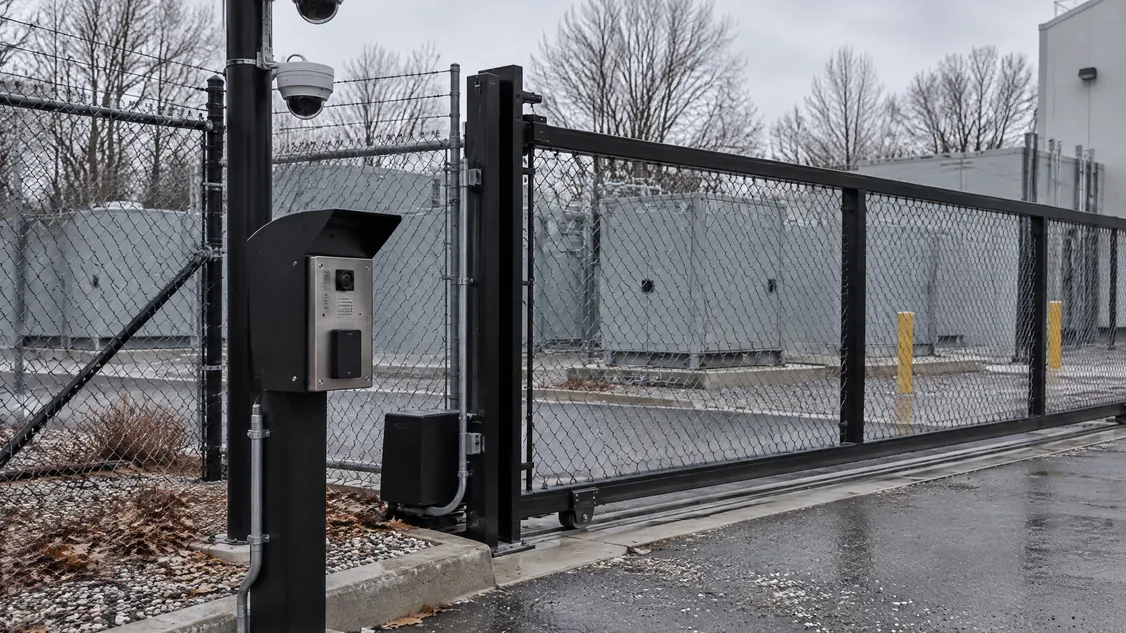
Exterior work deserves its own look. On the Toronto data centre Securitron worked on this year, cameras went on poles over the electrical switchgear yard and on a mast at the roof edge. Work like that raises questions outside the camera scope: who supplies the pole, who designs and pours the base, and who runs conduit across the yard.
Who supplies and wires electrified door hardware?
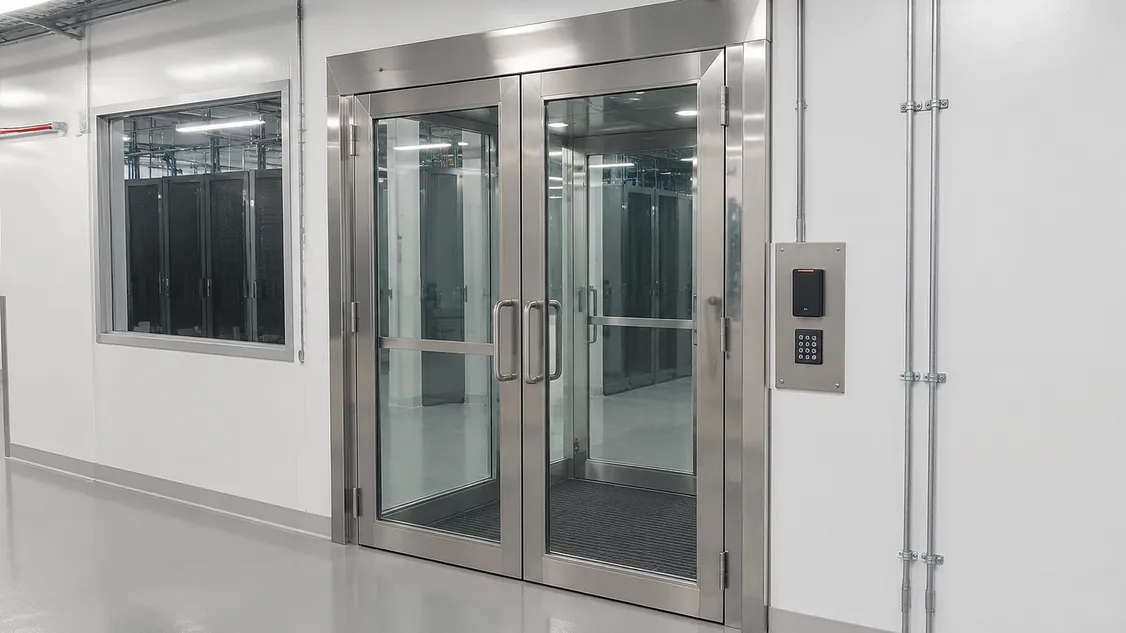
Electrified locks, strikes and exit devices are often specified in Division 08 (door hardware) and then wired, powered and programmed under Division 28. That split works when both sections name the same part and say who furnishes and installs it. When they don’t, a lock gets bought twice or not at all, and the door fails its first test.
In Allegion’s door schedule guide, specification manager T.J. Gottwalt gives the usual rule: “Anything that touches the opening (lock, reader, door position switch, etc.) is specified in Division 8.” The same guide notes that MasterFormat 2016 lets those items move into Division 28 when they are part of the access control system. You will see both patterns, so read both sections.
The gap is common. Writing in The Construction Specifier, ASSA ABLOY’s Larry Fosnight cites Dodge Construction Network data showing “90 percent of building projects in the United States do not have clear documents” to coordinate Division 08 and 28. That is US data, but his fix applies here too: “every component down to a conductor needs to be identified by who is providing it and who is installing it.” Our access control page covers how readers, locks and controllers work together.
Does the electrical contractor carry security rough-in and power?
The electrical contractor often carries security rough-in and power: conduit, back boxes and 120 V circuits for panels and lock power supplies. The security sub then carries low-voltage cable, devices and programming. That split only works if the electrical drawings show every reader, camera, door contact and panel. Any device missing from those drawings is a likely change order.
Timing drives the cost. A missed back box before drywall is a small fix. After the wall is finished, it means cutting, patching and painting, often by another trade. In the same Construction Specifier piece, Sean Ahrens of Affiliated Engineers urges integrators to visit before walls and ceilings close: “You do not want to discover a finished wall where those things are missing.” Get the security device layout to the electrical contractor before rough-in starts, and book one joint walk before close-in.
Where does the fire alarm meet the security scope?
Any exit door with a maglock (an electromagnetic lock) ties the security scope to the fire alarm. Toronto’s installer’s declaration for electromagnetic locking devices requires the lock to release when the fire alarm activates, on loss of power, on a fault in the circuit from the fire alarm panel, from a switch for authorized staff, and from a pull station within 600 mm of the door.
The same form says the installation “will not be acceptable to Building and Fire Services” unless the installer and the building owner both sign it and the fire alarm verification report is attached. That puts three parties on one door: the security sub, the fire alarm contractor and the verifier. The form cites article numbers from the 2012 Ontario Building Code, so ask your designer to confirm current requirements.
Maglocks also show up on the permit. Toronto’s fire and security upgrades permit page lists maglock layouts among the required floor plans and charges $46.40 per lock (to a maximum of $463.96) when they are permitted on their own. On a new build they typically ride in the main permit. Either way, schedule the fire alarm verification after the security interface is wired, or expect a second visit.
What should a Division 28 scope check cover before award?
A Division 28 scope check should focus on the edges of the package, where items fall between trades. It typically takes about an hour with the estimator, the electrical contractor’s PM and the security sub in the room. Use these questions:
- Which MasterFormat edition and which Division 28 sections are in the spec?
- Does every electrified opening have one named supplier, installer and power source?
- Do the electrical drawings show every security device and panel circuit?
- Who supplies cable for cameras and readers, and who supplies and configures the network switches?
- Which doors have maglocks, and who carries the fire alarm interface and verification?
- Who supplies poles, bases and trenching for exterior cameras?
- Who holds software licences and admin passwords at turnover?
- What does the closeout package need? Our data centre security closeout guide lists it.
Write the answers into a one-page responsibility matrix and attach it to the subcontract. It costs one meeting, which is usually far cheaper than a missed item found after close-in.
How can Securitron help with the Division 28 scope?
Securitron has installed and serviced access control, cameras, intrusion alarms and structured cabling across the GTA since 2008, and our data centre page shows the kind of work involved. If you’re pricing a data room or edge site, send us the drawings with the Division 08, 26, 27 and 28 sections, and we can go through the scope with you before bid day.
Frequently Asked Questions
Division 27 is Communications, the cabling and network side of the building. Division 28 is Electronic Safety and Security: access control, video and intrusion detection. On a data centre the two overlap because cameras and readers run on the network, so the spec should name one owner for each cable type and for the switch ports.
Either can work. Under the electrical contractor, pathways, power and security sit with one firm, which can make rough-in easier to coordinate. Direct to the GC gives the security sub a straight line to door hardware, IT and the owner. Either way, use the same responsibility matrix and attach it to the subcontract.
Before the electrical rough-in drawings are final, so device locations, back boxes and panel circuits are built where they belong. Bringing the security sub in after close-in typically means cutting finished walls or running surface raceway. On a fast build, that often means the shop drawing stage.
The spec or subcontract should say so in writing. Typically they are turned over to the owner with the closeout package, and the installer keeps only the access that the service agreement allows. If the documents are silent, settle it before award.
Securitron installs and services cameras, access control and alarms across the Greater Toronto Area and Hamilton, from our head office in Hamilton. That includes Toronto; Mississauga and Brampton in Peel; Vaughan, Markham and Richmond Hill in York Region; Oakville, Burlington and Milton in Halton; Pickering, Ajax, Whitby and Oshawa in Durham; and Hamilton, Guelph and Kitchener. For a job elsewhere in Ontario, call (905) 730-2425 to check.