Changing Construction-Site Security by Project Phase
Use phase gates to change construction-site fencing, cameras, access, monitoring and handover controls as GTA projects move from excavation to occupancy.
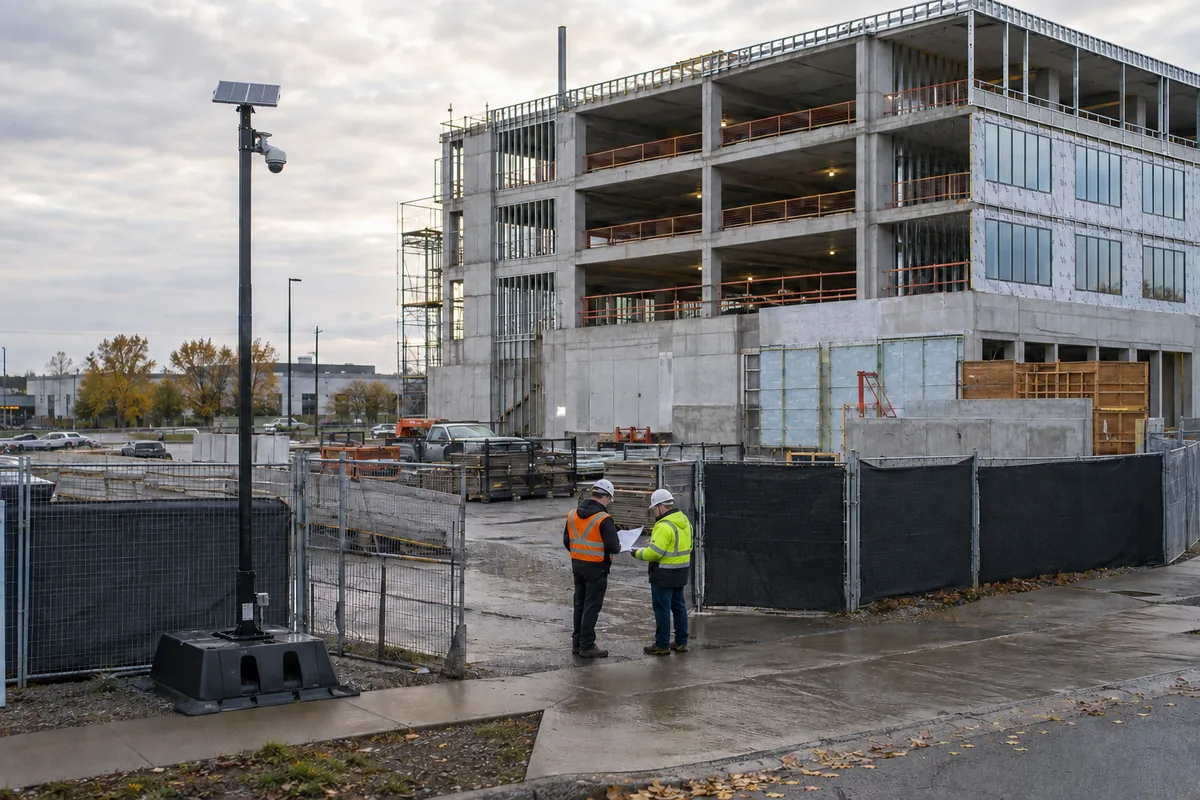
A construction-site security plan can keep working technically while protecting last month’s site. Excavation becomes structure, open floors become enclosed rooms, temporary power moves, valuable equipment arrives, trades change shifts and occupants may enter before construction is complete. Each transition can create a new opening, blind spot, false alarm or unclear responsibility.
The practical answer is a security phase gate: a short, evidence-based review triggered by a material site change. At each gate, update the site drawing, assets, access routes, operating hours, control locations, response plan and acceptance tests before the next exposure begins. This gives project managers a defensible way to decide what moves, what stays, what gets added and what can be retired.
Use this playbook with the broader controls in our Toronto and GTA construction-site security guide and the delivery options on our construction-site security industry page.
What is a construction security phase gate?
A security phase gate is a documented decision point that confirms temporary controls still match the site’s current assets, openings, people, infrastructure and operating conditions. It belongs in the project look-ahead process because construction changes create the need for the review.
Do not define gates only by percentage complete. Use observable triggers:
- a fence line, hoarding section, crane, scaffold or vehicle route moves;
- a new opening, stair, lift, roof route or enclosed floor becomes usable;
- temporary power, lighting or network service changes;
- generators, copper, controls, fixtures, appliances or finished materials arrive;
- a new trade, delivery window, second shift or weekend crew starts;
- permanent doors, access control, video or alarms enter commissioning;
- an owner, tenant or public-facing area becomes occupied; or
- the project changes from construction control to property operations.
The phase name provides context. The trigger tells the team when to act. A fast project may cross several triggers in one week, while another may remain in one condition for months.
Use one decision matrix across every project phase
The strongest phase plan connects each site condition to a control job, an owner and passing evidence. The following matrix is a starting point, not a prescribed equipment list.
| Project condition | Primary security decision | Minimum gate evidence |
|---|---|---|
| Pre-mobilization, demolition and site preparation | Define public boundary, authorized entry, off-hours response and temporary communications | Approved site plan, gate list, emergency contacts, after-hours schedule and communication test |
| Excavation, foundations and structure | Protect mobile equipment, fuel, laydown areas and changing vehicle routes without obstructing safe work | Updated perimeter and traffic drawing, lighting check, camera views, alarm schedule and outage test |
| Enclosure and building dry-in | Control the growing number of doors, openings, stairs and internal routes | Door and opening register, zone map, lock or credential schedule, blind-spot review and forced-entry alarm test |
| Rough-in and services | Match controls to high-consequence materials, equipment rooms and changing trade access | Asset map, authorized trade list, storage controls, service-room access test and delivery workflow |
| Fit-out and commissioning | Coordinate temporary and permanent systems while finishes and devices gain value | Commissioning matrix, key and credential register, monitoring route test, privacy review and deficiency log |
| Partial occupancy and handover | Separate occupied and construction zones, preserve safe egress and transfer accountability | Boundary drawing, representative life-safety interface tests, revoked construction access, retained evidence and signed handover |
Ontario’s current Construction Projects regulation requires written emergency procedures, ready access to two-way communication and regular inspection of specified project equipment and conditions, including electrical installations, communication systems, structures and means of access and egress. These are occupational health and safety duties. A security review should coordinate with them and must never substitute for required safety inspections, emergency planning or competent-person decisions.
Phase 1: establish a controlled boundary before infrastructure exists
Early work often has the weakest power and connectivity and the most changeable perimeter. The first gate should establish who can enter, how a responder receives an alarm and which controls remain available during an outage.
Record every vehicle and pedestrian entrance, public interface, contractor parking area, equipment storage point and temporary office. Where work may endanger a person using a public way, Ontario’s construction regulation contains specific public-way protection requirements. Site leadership should confirm the applicable barrier, covered-way, lighting and traffic-control obligations with the appropriate competent parties. Security equipment and fencing cannot reduce safe sightlines, create trip hazards or interfere with required access.
If a mobile video or alarm unit is proposed, test the real installation location. Confirm stable ballast, tamper exposure, solar access if applicable, cellular signal, low-light view, notification path and the named person who can assess an alert. A product specification or dashboard status does not prove the site workflow will work.
Pass this gate only when an after-hours alert can travel from the field device to an accountable responder and the responder has a safe, current escalation procedure.
Phase 2: move coverage as structure and logistics change
Excavation, forming, concrete and structural work continually alter elevation, line of sight and vehicle movement. A camera that covered a laydown area last week may now face a wall, scaffold, stacked formwork or relocated gate.
Reconcile the two-week or three-week look-ahead with the security drawing. For every planned move, ask:
- Which view, alarm zone, light or barrier will be blocked or removed?
- Which new route or stored asset becomes exposed?
- Does the move change power, network, mounting height or maintenance access?
- Will legitimate early, late or weekend work trigger monitoring rules?
- Who approves the new position and who verifies it after installation?
Official AXIS Site Designer documentation illustrates the engineering variables that a video design should document: mapped coverage, scene and lighting conditions, schedules, power, bandwidth and storage estimates. It also states that generated power, bandwidth and storage values are estimates. The selected products and actual site conditions still require field testing.
Use one day and one night acceptance image from each decision area. Verify that a person or vehicle takes up enough of the image for the intended task, that glare and temporary lighting do not hide the subject, and that the recording can be retrieved through the approved workflow. Avoid promising identification from a wide overview view that was designed only for detection or situational awareness.
Phase 3: control openings when the building becomes enclosed
Enclosure shifts the problem from an open perimeter toward many doors, temporary closures and internal routes. The team needs a door and opening register before improvised locks and shared keys multiply.
Give every controlled opening a stable identifier tied to the drawing. Record its purpose, hardware, permitted users, schedule, status sensor if used, emergency behaviour, inspection owner and retirement condition. Include temporary stairs, roof access, loading points, hoists and passages between secured and active work zones.
Create internal zones only where they support a defined decision. A zone could protect a service room, tool crib, finished floor or material cage. Overly broad access makes activity hard to attribute. Excessively narrow rules can disrupt legitimate work and lead crews to prop doors. Test a normal entry, a denied entry, a held-open condition and the after-hours response with the people who actually operate the area.
Phase 4: protect rough-in assets without losing the workflow
Mechanical, electrical, communications and controls work brings smaller, portable and often project-critical assets onsite. The phase gate should identify where those assets wait, who needs them, how deliveries are accepted and how exceptions are handled.
Use the procurement and delivery schedule as evidence. List high-consequence items by location and time window rather than assuming all materials deserve the same control. Move priority items into controlled storage, reduce unnecessary dwell time and assign a receiving owner. Reconcile delivery records with access events where appropriate.
Public construction discussions repeatedly ask whether a camera will prevent loss, provide useful evidence or alert someone while an event is happening. Those posts are anecdotal and geographically mixed, but they reveal a practical buyer question. Answer it in the design: state whether each device is intended to deter, detect, assess or support investigation; identify who receives the event; set the expected assessment and escalation workflow; and test the exported evidence. A camera with no defined response can still record an incident, but it does not create an intervention process by itself.
Phase 5: coordinate temporary and permanent systems during commissioning
Commissioning creates two overlapping environments. Construction keys, temporary alarms and mobile cameras may remain active while permanent doors, credentials, networks and video systems enter testing. Treat the overlap as a controlled migration.
Build a commissioning matrix with each door, camera, alarm input, communication path and monitoring destination. For every item, record temporary state, permanent state, test owner, dependency, rollback, deficiency and acceptance date. Keep temporary coverage in place until representative end-to-end workflows pass.
The RCMP’s 2024 physical-security facility design guide advises Government of Canada projects to report security considerations to the project manager and build them in at the earliest possible phase, based on a threat and risk assessment. It does not prescribe commercial construction equipment. The transferable lesson is governance: security requirements, design decisions and residual risks need a visible place in project management.
Camera purposes may also change as the public, occupants or finished tenant areas enter view. The Office of the Privacy Commissioner of Canada’s overt video-surveillance guidance says organizations should establish a business reason, limit viewing range, provide notice, secure access and storage, destroy recordings when no longer required and periodically evaluate the need. The guidance covers overt surveillance of the public in publicly accessible private-sector areas and explicitly excludes employee surveillance. Obtain appropriate privacy and employment-law advice for the actual site, workforce and jurisdiction.
Phase 6: make partial occupancy and handover explicit
Partial occupancy is a high-consequence transition because occupants, contractors, deliveries and incomplete work can share a site. Draw the boundary between occupied, construction and shared areas. Name who controls each entrance and who can authorize a boundary change.
Verify that security arrangements preserve required egress, accessibility, emergency access, fire-protection functions and safe circulation. These decisions belong with the building, fire and health-and-safety authorities responsible for the project. Never accept a security measure that compromises a life-safety requirement.
Use a transition checklist:
- test representative permanent doors, alarms, cameras and monitoring paths end to end;
- reconcile physical keys, badges, mobile credentials and visitor permissions;
- remove construction master access from occupied areas unless specifically approved;
- close temporary vendor and service accounts that are no longer required;
- export and protect evidence that must remain available under the approved policy;
- apply the approved retention and deletion decisions to temporary recordings;
- remove devices, power supplies, network services and mounts without leaving hazards;
- transfer drawings, passwords, licences, warranties, test results and deficiencies; and
- obtain named acceptance from construction, property operations and relevant technical owners.
The RCMP’s facility security assessment and authorization guide is written for Government of Canada facilities, yet its project structure reinforces a useful handover principle: define stakeholder responsibilities early, connect security deliverables to project phases, authorize occupancy and include decommissioning. Commercial teams should tailor that discipline to their own contracts, authorities and risks.
Put the phase gate into the look-ahead meeting
Add a standing security-change item to the look-ahead agenda. The meeting should identify triggers, assign field verification and approve changes before work removes an existing control.
The gate package should contain:
- a dated site plan with current and next-phase boundaries, openings and routes;
- an asset and delivery change list;
- device positions, intended tasks and day/night reference views;
- power, network, storage and communication assumptions;
- authorized hours, trades, deliveries and monitoring exceptions;
- alarm contacts, response steps and escalation authority;
- privacy purpose, viewing area, access and retention decisions;
- test results, deficiencies, temporary compensating controls, owners and due dates; and
- approval to proceed or a documented stop condition.
Keep the process proportional. A shifted fence panel may need a quick drawing and field check. Partial occupancy needs a cross-functional review and signed acceptance. The value comes from making the decision visible before the exposure changes.
Test the transition before accepting it
Run acceptance tests against the intended operational result, not just device connectivity.
| Test | Passing evidence |
|---|---|
| Planned outage | Critical temporary controls continue through the documented backup period or fail through the approved escalation path |
| New gate | Authorized entry and delivery pass; denied and held-open events follow the approved workflow |
| Changed camera view | Current day and night images cover the defined decision area with retrievable recording |
| Schedule exception | A legitimate early crew is handled without an avoidable dispatch, while an unauthorized event still escalates |
| Phase boundary | A person cannot move from the construction zone into the occupied or protected zone through an unapproved route |
| Monitoring handoff | The correct responder receives the event, can assess it and follows the current contact tree |
| Evidence export | An authorized user can locate, export, protect and document a representative event |
| Decommissioning | Retired credentials, accounts and devices no longer provide access or send stale events |
Record the date, conditions, participants, evidence and exceptions. Re-run the affected test after a material change. A green icon in a portal proves only the status that portal measures.
Ask vendors questions that expose a static plan
Put these questions in the proposal and each phase review:
- Which site changes trigger a survey, drawing update or equipment move?
- Who compares the security plan with the construction look-ahead, and how often?
- What temporary power, cellular, network and storage assumptions does the price rely on?
- Which control performs detection, assessment, delay, response or evidence collection?
- How will lighting, scaffolding, hoarding, new walls and stored material affect coverage?
- How are legitimate schedule changes communicated to monitoring before a shift begins?
- What tests prove the view, alarm path, access rule and response workflow after relocation?
- Who owns permits, privacy notice, recording access, retention and deletion decisions?
- What happens during a carrier, power, device or monitoring outage?
- How will temporary and permanent systems overlap, roll back and transfer at handover?
- Which drawings, configuration, licences, credentials and test records does the customer receive?
- What conditions allow temporary controls to be removed, and who signs acceptance?
A phase-based plan turns site change into a managed decision. Securitron Canada can help a GTA project team define the phase gates, temporary controls, acceptance tests and handover evidence appropriate to its construction schedule and operating responsibilities.
Frequently Asked Questions
Change it when the exposure changes, not only on a calendar date. Useful triggers include a moved perimeter, a new vehicle gate, loss or addition of power and connectivity, enclosure of the building, arrival of high-consequence materials or equipment, a new shift pattern, commissioning of permanent systems, partial occupancy and handover.
Only if a documented test shows that each camera still covers its current decision area with usable images under current light, motion, power, network and retention conditions. Structure, hoarding, scaffolding, stored materials and new access routes can create blind spots. Repositioning may also change privacy impacts.
Produce an approved site plan, asset and access changes, updated camera and lighting views, current monitoring schedules and contacts, power and communication checks, privacy and retention decisions, acceptance-test results, open deficiencies, owners and due dates. Keep the package with the project change record.
The constructor or general contractor should name one accountable project role, while trade, property, security, IT, health and safety and fire-safety responsibilities remain clearly assigned. The integrator can test and document systems, but site leadership must approve operating rules, schedules, escalation contacts and accepted residual risk.
Run both under a written transition plan until representative doors, alarms, cameras, communications, credentials, monitoring routes and emergency interfaces pass acceptance tests. Revoke construction credentials, recover keys, export required evidence, apply the approved retention rule, remove temporary accounts and devices, and obtain named sign-off before closing the temporary service.