Construction Site Security in Toronto and the GTA
Build a layered construction security plan around changing site conditions, controlled access, material custody, verified alarms, and rapid response.
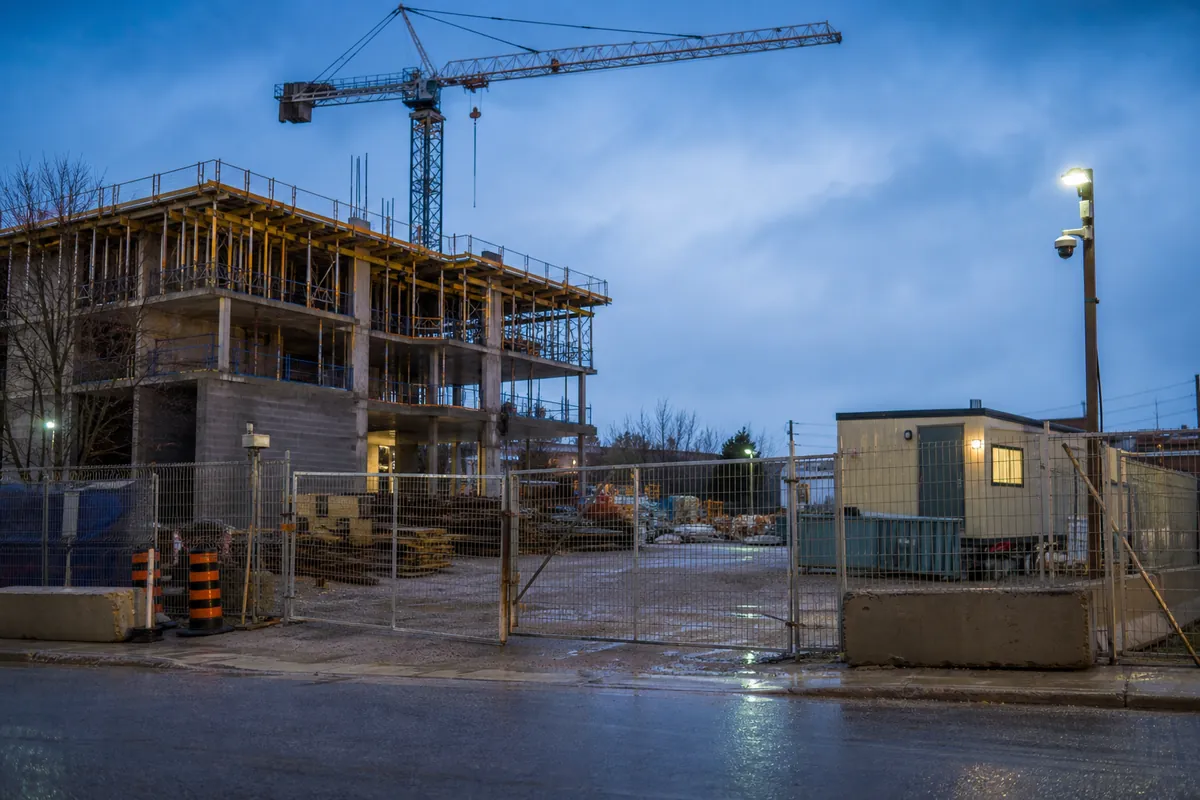
Construction sites change faster than permanent security systems. Fences move, walls close, temporary power disappears, trades rotate, deliveries peak, and sightlines vanish. A useful security plan must evolve with the construction schedule.
Establish Governance Before Mobilization
Assign one accountable site-security owner and document the roles of the general contractor, owner, property manager, guard provider, monitoring station, integrator, IT team, and emergency contacts.
Create a short site security plan that includes:
- current perimeter and controlled gates;
- operating hours and authorized exceptions;
- personnel, visitor, and vehicle entry process;
- high-value materials, tools, fuel, and equipment zones;
- key, credential, and lock control;
- lighting, camera, intrusion, and communication assets;
- alarm verification and escalation;
- incident preservation and reporting;
- weekly change review;
- severe weather, power, and connectivity contingencies.
Tie plan updates to the look-ahead schedule. Security should be reviewed when hoarding moves, a crane is removed, glazing begins, permanent doors arrive, floors become accessible, or occupancy starts.
Use Layers With Different Jobs
Each layer should deter, detect, delay, help assess, or support response.
Perimeter
Maintain continuous fencing or hoarding, eliminate climb aids, stabilize gates, close gaps beneath panels, and keep stored materials away from the boundary. Inspect after high winds, heavy activity, and public events.
Entry control
Reduce the number of active gates. Define separate pedestrian and vehicle flows where practical. Record deliveries, manage temporary credentials, and ensure departing vehicles and materials follow an approved process.
Asset control
Use locked containers or rooms, immobilization, tool accountability, delivery timing, and limited key access. Place the most valuable or portable assets inside additional controlled zones rather than relying on the perimeter alone.
Detection and assessment
Position temporary intrusion sensors and cameras around likely approach paths, gates, compounds, vertical access, and critical equipment. A verified alarm should show enough context for an operator to distinguish weather, an animal, an authorized trade, and a genuine intrusion.
Response
Write who receives the alarm, what they can verify, who may attend, when police or fire services are contacted, and how responders enter safely. Keep gate codes, hazards, and site-contact information current.
Design for Temporary Power and Connectivity
Map the power source and runtime for every critical device. Temporary circuits can be switched off without warning, and extension-based power may not survive site reconfiguration.
For cellular or wireless paths, test signal at the installed height and location, then monitor connection health and data use. For wired paths, protect cables from vehicles, cutting, water, and trade work. Use battery or alternate-path capability according to the required response window.
Never assume a green status in an app proves the complete alarm path. Test sensor, device, network, platform, notification, operator, and response together.
Make Cameras Follow the Risk
At each project phase, update a view schedule. Record the risk, field of view, night condition, obstructions, privacy impact, and relocation trigger for every camera.
Avoid mounting temporary devices so high or wide that people become unidentifiable dots. Pair an overview with tighter gate or access views. Check infrared reflection from mesh, plastic wrap, dust, snow, and nearby walls. Re-test after floodlights, trailers, scaffolding, and construction material move.
The Office of the Privacy Commissioner of Canada recommends a defined purpose, limited viewing range, notice, restricted access, secure storage, and deletion when footage is no longer required. Temporary sites still need those decisions.
Control People, Credentials, and Keys
Use named credentials where possible and expire them with the work assignment. Separate site access from access to trailers, electrical rooms, material cages, finished suites, and owner areas. Review active credentials against current subcontractors.
For mechanical keys, maintain issue, return, and lost-key records. Rekey or retire temporary construction cylinders before handover according to the turnover plan.
Protect the Transition to Occupancy
Risk rises when permanent systems, finishes, appliances, and owner equipment arrive while construction access remains broad. Build a transition matrix showing:
| Phase | Security change |
|---|---|
| Building enclosed | Move from perimeter-only to door and interior-zone control |
| Permanent power live | Transfer critical devices through tested outages |
| Access control commissioned | Stop issuing uncontrolled construction keys |
| Tenant or owner equipment arrives | Create restricted custody zones |
| Partial occupancy | Separate occupied and construction paths |
| Handover | Remove temporary accounts, devices, links, and data |
Audit Weekly
A short weekly walk should verify fence continuity, gate control, lighting, camera views, alarm health, call lists, high-value storage, credentials, keys, signage, and upcoming schedule changes. Track deficiencies to an owner and due date.
Security succeeds when it is part of site coordination. The goal is not a perfect temporary fortress; it is a current, tested system that keeps risk controls aligned with the project as it changes.
Frequently Asked Questions
Security planning should begin before mobilization so fencing, gates, lighting, temporary power, material zones, camera locations, and response responsibilities are coordinated instead of added after valuable assets arrive.
Usually not. Site geometry and risks change by phase. Use layered perimeter, gate, material, vertical-access, and critical-equipment coverage, then relocate devices through a documented change process.
An actionable alarm identifies the zone, presents useful verification, reaches a trained recipient, and has a current response procedure. Connectivity, power, call-list, and response tests should be repeated throughout the project.