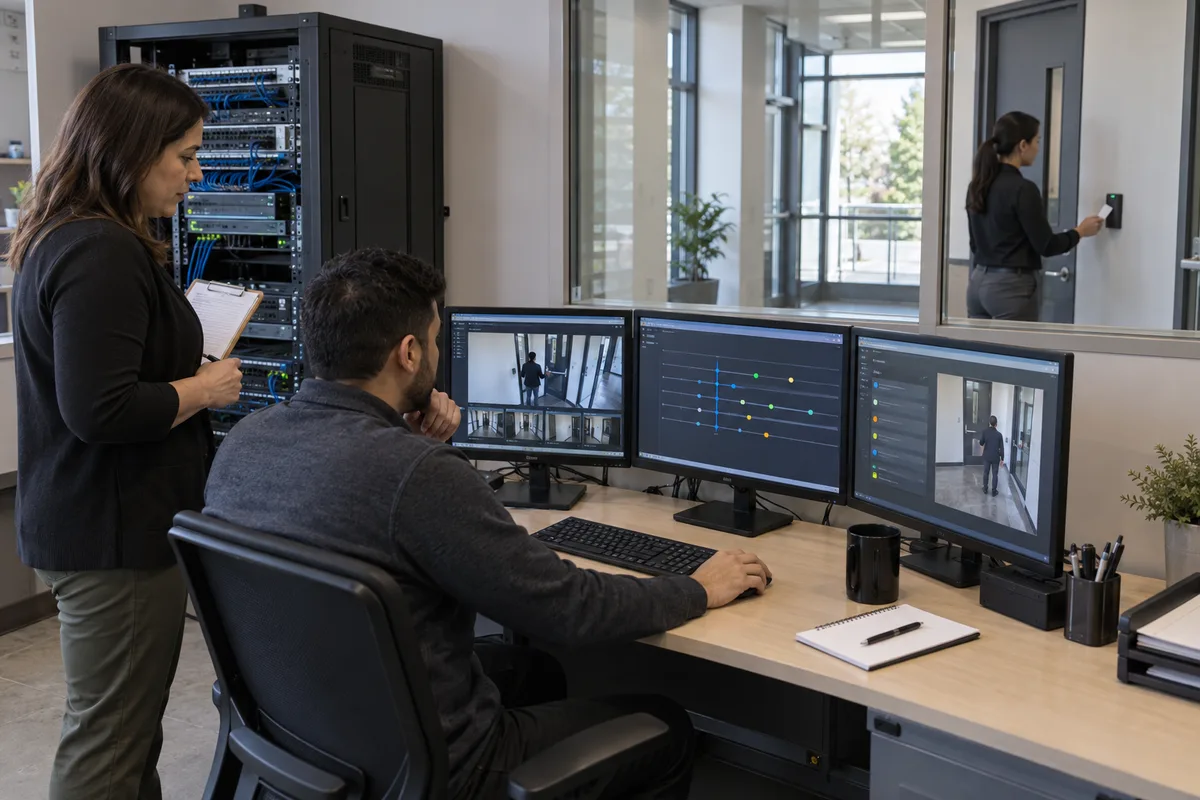
Defining Service Levels for Commercial Security Systems
When security equipment fails, how long until protection returns? Understand repair promises, after-hours help, warranty gaps and escalation.
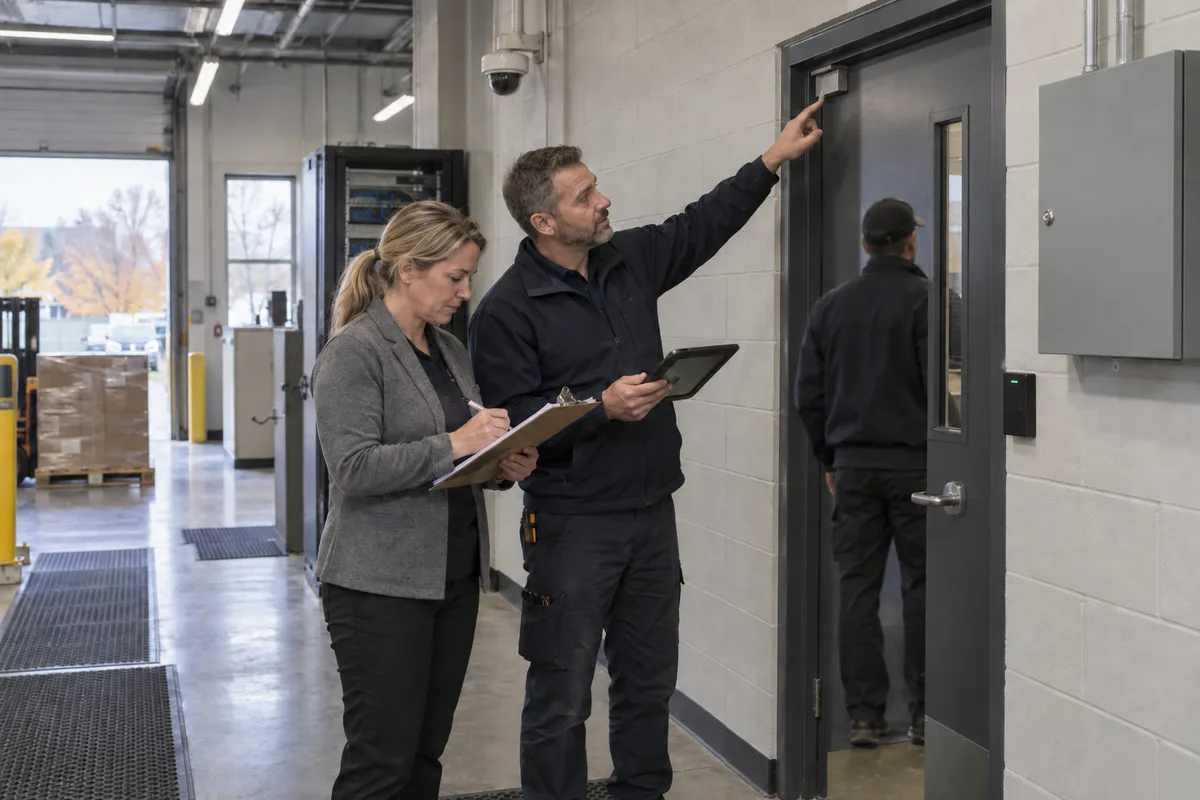
When a service goes down, the question that matters is simple: when can you rely on it again? On March 11, 2026, the CRTC sought further information while reviewing challenges to Canada’s major telecom outage-reporting requirements. Its questions included how long outages lasted and how many people were affected. The CRTC’s published letter concerns telecommunications, without setting repair deadlines for security installers.
For a business relying on cameras, controlled doors or alarms, the practical lesson is to separate a provider’s reply from the return of the function you need. A service-level agreement, or SLA, should explain what happens first, when working protection should return, and who takes over if the plan falls behind. Start with the consequence your site can tolerate, then agree measurable commitments around it.
How long could we be left without working protection?
Your agreement should answer that question for each important failure. A general promise of fast support leaves too much room for different interpretations.
Consider an illustrative warehouse example. The manager can see live camera pictures, but discovers that new footage is no longer being recorded. A quick callback helps start diagnosis. Until recording resumes, the business may have no footage to review for that interval. Restoring the recorder later cannot recreate video that was never captured.
That consequence is different from losing remote viewing while local recording continues. Both may look like a camera problem to the person making the call. They need different explanations, priorities and temporary arrangements.
Ask the provider to describe what remains working, what has stopped and what the next shift needs to know. An honest diagnosis may show that existing protection is adequate while a convenience feature is repaired. It may also reveal a gap that warrants immediate attention. Neither conclusion requires assuming that an incident is about to happen.
This is where a support agreement connects to the purpose of your commercial security systems: keeping agreed functions available and making limitations visible when they are unavailable.
What does “we will respond” actually promise?
Ask which event stops the response clock. A message saying your request has been received can satisfy one kind of promise while leaving the underlying problem untouched.
Use the following distinctions when reading a quote. These are proposed plain-language definitions to agree with your supplier; the wording in your actual contract controls.
| Promise | What you should be able to observe |
|---|---|
| Acknowledgement | A person confirms the affected site, understands the reported impact and takes ownership. |
| Attendance | A qualified person starts the agreed remote work or arrives on site, as specified. |
| Temporary protection | An approved interim arrangement reduces the identified gap, with its limits explained. |
| Restoration | The agreed function works again and has passed the agreed check. |
| Permanent repair | Remaining temporary equipment or unresolved underlying faults have been addressed. |
A temporary arrangement needs its own description. For example, an approved staff procedure might help control entry while a reader is repaired. It does not automatically restore the normal access-control service. Record who approved it, what it leaves uncovered and when it will be reviewed.
Canada’s Treasury Board service-agreement guidance, published in 2012, recommends targets expressed in business terms that the client can understand. It identifies recovery or repair time, responsibilities, measurement and exceptions among relevant elements. That is useful agreement-design guidance, developed for government service relationships, rather than a mandatory repair schedule for a private business.
Which problems deserve the fastest help?
Prioritize the effect on your operation, including whether a workable alternative exists. Counting faulty devices alone can produce an unhelpful answer.
A single failed component might affect the only controlled entrance to a restricted area. Several failed cameras might leave an area covered by other working views. The urgency depends on what people can still do and what protection remains.
Discuss a small set of site-specific severity levels with the people who run the building. At the highest level, describe the loss of an essential function without an acceptable alternative. A lower level might cover reduced capability with a tested alternative. Routine changes can have a separate planned-work schedule.
Write the examples in language the person reporting the fault can use: “The entrance will not secure,” “We cannot retrieve recordings,” or “The alarm cannot send its signal.” Have the provider confirm the severity and explain any proposed downgrade. Nominate someone on your side who can challenge that decision when operational conditions have been missed.
Keep emergency action separate from the repair queue. An immediate threat to people needs the site’s emergency procedure. Staff should never wait for an SLA deadline or alter exit hardware themselves to work around a fault. Qualified professionals should assess changes involving door safety or regulated systems.
What happens if it fails after everyone has gone home?
The agreement needs an after-hours route that reaches someone able to act. Round-the-clock monitoring, telephone support and technician availability should each be confirmed separately.
Toronto offers a useful local example of making that distinction visible. A published agreement between Toronto Corporate Security and the Toronto Parking Authority, signed in 2021 and included in 2025 committee records, directs security-system repair requests through a service process and identifies an after-hours Security Control Centre contact. It documents that organization’s arrangements; it does not establish service levels for other properties.
For your site, clarify whether the clock runs through nights, weekends and holidays. Specify the approved reporting channel and whether timing begins when an automatic fault is detected or when someone reports it. A fault that nobody is responsible for noticing can remain outside a ticket-based promise.
Then check the practical dependencies. Who lets the technician in? Who can approve extra spending? Can IT provide authorised remote access? Who contacts the internet provider if the connection is involved? Name a coordinator so that you do not have to repeat the same story to every supplier.
If the contract permits pauses while awaiting access or a part, require the reason and timestamps to remain visible. Ask to see both the measured contract time and the total time the function was unavailable. Those answer different questions about the service you received.
Does the warranty mean the whole repair is covered?
Read the hardware warranty alongside the service quote. They address different parts of the recovery process.
For example, Axis’s current warranty page describes repair or replacement for covered defects in design, workmanship and material under normal use, with product exceptions. That description alone does not tell your business who will remove the device, travel to the site, configure the replacement or prove the system works afterwards. Confirm those arrangements in writing for your actual equipment.
Ask for the cost of the full recovery path: diagnosis, attendance, access equipment, replacement or loan equipment, installation and testing. Identify after-hours charges and any approval limit. Avoid accepting an undefined “parts extra” line when an unavailable part could leave an essential function down.
Faster commitments can require reserved staff or suitable spare equipment. Whether that effort is worthwhile depends on the consequence of waiting. You might need enhanced cover for a critical entrance while retaining ordinary support for less consequential faults. If existing support meets your needs, clarifying responsibilities and testing the contact route may be sufficient. A new system is not an automatic requirement.
Who takes over when the promised time is missed?
Agree escalation before a fault occurs, including who contacts whom and what changes when a target is at risk.
A useful update explains the present impact, work completed, remaining obstacle, next action and next update time. If a restoration estimate is uncertain, the provider should say what still needs to be established. A confident but unsupported deadline can leave you planning a reopening or shift change around information that will not hold.
Ask for a named service-management role above the initial help desk, together with a backup route. Escalation should trigger a recovery decision, such as arranging specialist support or an approved temporary measure. Include an owner and deadline for finishing the permanent repair after an interim solution is accepted.
Agree how missed commitments will be reviewed and what contractual remedies apply. A service credit can address the bill; it cannot recover missing footage or staff time already spent managing a disruption. Have legal advisers review enforceability, liability and remedies for your circumstances.
If a supplier refers to ISO/IEC 20000-1:2018, ask how its service-management approach appears in your agreement. ISO describes a standard for establishing and improving a service management system. The reference alone does not tell you the restoration deadline for your door or recorder. Your written commitments and actual performance still need checking.
What can we check before renewing?
Walk through one realistic failure with your provider before buying a higher service tier. A discussion using a clearly labelled test ticket can reveal unclear ownership without disabling a working system.
Choose the function whose loss would cause the most difficult day. Ask the person who would report it to find the right contact and explain the impact. Then have the provider show how acknowledgement, severity, attendance, restoration and escalation would be recorded. Agree the actual numerical targets and coverage hours together; there is no universal response time proposed here for every property.
Use these questions to finish the exercise:
- What exactly would be unavailable, and what could continue operating?
- Who would own the problem after hours, including supplier handoffs?
- What deadline would apply to restoring that function, and what could pause it?
- What would we pay, and who could approve additional work?
- What check would let us confidently say the service had returned?
For recording, that final check might include retrieving newly recorded footage from the affected view. For a controlled door, agree a qualified technician’s safe functional check and the evidence the facilities team will receive. Avoid unscheduled alarm or access tests that could disrupt occupants or emergency arrangements.
Keep the agreed answers with your commercial security request for proposal so bidders price the same support outcome. The next useful step is a review of your most consequential gap and its recovery plan. Securitron can help you assess the system scope and support needs before you decide whether a change is warranted.
Frequently Asked Questions
Only if the agreement explicitly promises that outcome. Response might mean a reply, remote troubleshooting or arrival. Ask for separate deadlines for acknowledgement, restoring the affected function and completing any permanent repair.
Check the separate service terms. Monitoring, technical support and on-site repair are different activities. Confirm who receives a fault report after hours, whether a technician can attend and what additional charges require approval.
Read the product warranty and installer agreement together. A manufacturer may repair or replace a defective device, while removal, travel, reinstallation, configuration and testing need separate arrangements. Ask for written inclusions rather than assuming the warranty covers the whole visit.
Use the named escalation contact, request an updated recovery plan and confirm who is managing any temporary protection. Preserve the ticket timeline and review the agreed remedy. An immediate safety emergency should follow your emergency procedure, without waiting for a service-contract deadline.