Calculating Commercial Security System Total Cost of Ownership
Compare commercial security proposals with a complete TCO model covering implementation, operations, support, renewal, risk and exit costs.
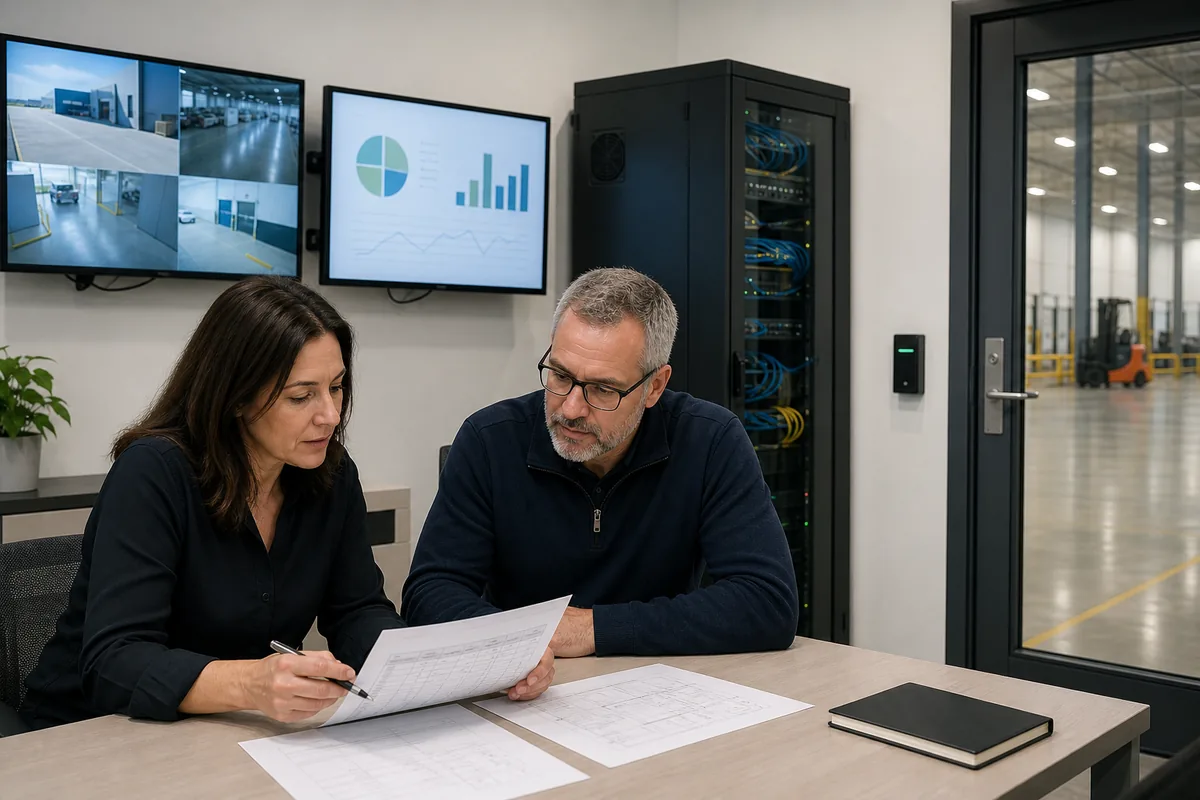
The lowest commercial security bid can become the most expensive option after subscriptions, internal administration, storage growth, support limits, service calls and migration are counted. Finance, facilities and procurement teams need every bidder priced against the same operating outcome and the same analysis period.
Use a total cost of ownership model that shows acquisition, implementation, recurring operations, internal labour, maintenance, planned renewal, transition and risk-related costs by year. Normalize the scope and service level first. Then compare base, low and high scenarios for the few assumptions that materially change the result.
This approach produces a defensible purchasing decision. It also reveals missing information while there is still time to request a binding answer from the vendor.
What total cost of ownership should answer
Total cost of ownership, or TCO, estimates the resources required to acquire, operate, sustain and retire a system over a defined period. The Government of Canada’s Guide to Costing recommends clear boundaries for time and scope, inclusion of related costs such as inflation, internal services and lifecycle costs, and explicit treatment of uncertainty and risk. It describes planning, acquisition, operations and sustainment, and disposal as lifecycle phases.
Public Services and Procurement Canada’s current life-cycle costing guidance similarly spans planning, acquisition, utilization and disposal. These federal sources govern their stated public-sector contexts, but the costing discipline is useful for private commercial security procurement.
A decision-ready model should answer:
- What performance and service level are being purchased?
- Which costs occur before operation, annually, periodically and at exit?
- Which party pays each cost?
- Which price elements can increase, and by what rule?
- What assumptions drive storage, licences, labour and replacement?
- What happens if quantities, retention, support dates or contract length change?
- Which costs remain uncertain, and how much could they move the result?
TCO is a cost comparison. Benefits, risk reduction and return on investment require a separate evidence-based analysis. Keeping those calculations distinct prevents optimistic benefit estimates from hiding a costly ownership model.
Normalize the operating requirement before comparing prices
Two proposals cannot be compared fairly when they promise different outcomes. Write a common requirements baseline before entering any price into the model.
For video, define camera count and purpose, recorded resolution, frame rate where material, retention, recording mode, export workflow, user count, viewing locations, health monitoring and response expectations. For access control, define controlled openings, credential population, visitor and mobile-credential requirements, integrations, event retention, offline behaviour and administrative workflow. For intrusion and monitoring, define points, partitions, communication paths, verification, response, testing and reporting.
Also document shared infrastructure:
- cable pathways, lifts, permits and restoration responsibilities;
- switches, PoE capacity, servers, storage and UPS coverage;
- cloud bandwidth, cellular service and data allowance;
- identity, directory, email, mobile and API dependencies;
- cybersecurity and privacy controls;
- training, documentation and administrative ownership; and
- service hours, response targets, spares and escalation.
Create a compliance matrix with one row per requirement. Require bidders to mark each item as included, excluded, optional, dependent on a third party or requiring customer labour. Price cannot compensate for a missing critical outcome.
Build the TCO equation and cost ledger
Use one ledger with a row for every cost element and a column for every year. A practical equation is:
TCO = acquisition + implementation + recurring service + internal operations + maintenance + capacity and change + planned renewal + transition and disposal + separately stated risk allowance
The Innovation, Science and Economic Development Canada sustainable purchasing guide describes TCO as acquisition plus staff, training, support equipment, logistics, operating, maintenance, withdrawal and disposal costs. Translate those categories into security-specific line items:
| Cost group | Security-system line items to request |
|---|---|
| Acquisition | Cameras, readers, locks, panels, sensors, servers, storage, network equipment, UPS, licences and spares |
| Implementation | Survey, engineering, project management, installation, cable, conduit, lifts, configuration, integration, testing, documentation and initial training |
| Recurring service | Monitoring, cloud, software assurance, support plans, cellular, connectivity, certificates and third-party services |
| Internal operations | User administration, credential handling, evidence export, privacy requests, audit review, patch coordination, vendor management and refresher training |
| Maintenance | Inspection, cleaning, testing, batteries, storage drives, repairs, truck rolls, loaners and after-hours premiums |
| Capacity and change | Added cameras or doors, retention growth, licence tiers, storage, bandwidth, integrations, renovations and site expansion |
| Renewal | Supported replacement, software migration, controller or server refresh, parallel operation and retraining |
| Exit | Data export, configuration handover, credential migration, removal, restoration, secure disposal and contract termination fees |
Every row needs a quantity, unit, unit price, timing, escalation rule, tax treatment, source and confidence level. Record whether the amount is fixed, estimated, allowance-based or excluded. Show Canadian dollars consistently and state how recoverable taxes are handled.
Put internal labour and operational friction into the model
Cloud and on-premises proposals often move work between the vendor, IT, facilities and security teams. Count the work wherever it lands.
Estimate annual hours for:
- adding, changing and removing users or credentials;
- reviewing system health and unresolved faults;
- applying firmware, software and certificate updates;
- testing cameras, doors, alarms, backups and recovery;
- exporting video and access records for authorized requests;
- maintaining drawings, inventories and procedures;
- managing privacy access, preservation and deletion workflows;
- coordinating vendors, renewals and service incidents; and
- training new administrators and operators.
Calculate internal labour as hours by role multiplied by a finance-approved loaded rate. Keep the hours visible. A low assumed hourly rate should never conceal a workflow that consumes hundreds of staff hours.
Measure operational friction during demonstrations and pilots. Time common tasks such as finding an incident, revoking a credential across sites, confirming a camera outage and exporting evidence. Use representative users and record the conditions. A polished sales demonstration provides context, while a repeatable task test provides cost evidence.
Price support horizons, warranty limits and cybersecurity work
Support language affects replacement timing and emergency cost. Require the manufacturer and bidder to provide, for each material component:
- warranty start, duration, remedy and exclusions;
- responsibility for removal, labour, shipping and reinstallation;
- end-of-sale, final-order and end-of-support dates;
- security-update and operating-system support policy;
- spare and replacement-product availability;
- supported upgrade path and migration tools; and
- required subscriptions or support contracts.
Manufacturer terms vary and can change. Axis’s current post-discontinuation support policy, for example, describes a five-year limited hardware warranty for most eligible hardware, support and RMA service for discontinued products for up to six years after discontinuation, and AXIS OS support through the product lifetime and at least five years after discontinuation. The same policy excludes shipping and certain related costs from the hardware remedy and states different treatment for software. Use such documentation to populate model-specific assumptions, then retain the version reviewed with the procurement record. These Axis terms are one manufacturer’s current policy and do not establish a market-wide lifespan.
Cybersecurity is an operating responsibility with labour and service costs. Include asset inventory, secure configuration, network changes, administrator protection, vulnerability review, update testing, backup, certificate renewal, incident support and documented retirement. Ask which party monitors manufacturer notices, approves downtime, tests updates, performs rollback and proves completion.
Test interoperability claims and future choice
Open interfaces can reduce some migration and integration costs when the required functions are genuinely supported. Procurement language needs the exact profile, product and function.
ONVIF Profile T covers defined video functions including H.264 and H.265 streaming, imaging, metadata, motion and tampering events, with some conditional capabilities. ONVIF Profile A covers access-control configuration involving credentials, access rules, schedules and events. Profile conformance has a defined scope. It does not prove that every analytic, integration or workflow will operate across a proposed system.
For every interoperability claim, request:
- exact manufacturer and model;
- exact ONVIF profile or other standard;
- evidence that the product is conformant, where applicable;
- required and conditional functions used by the design;
- tested software and firmware versions;
- licences and middleware required;
- limitations, workarounds and vendor-specific dependencies; and
- an acceptance test using the proposed combination.
Add likely migration work to TCO even when standards are present. Configuration mapping, event logic, credentials, historical data, user training and parallel operation may still require effort.
Compare proposals on a common timeline
Choose an analysis term that captures the contract, expected support horizon and at least one meaningful renewal decision. Use the same start date and annual periods for all bidders.
Build three views:
- Undiscounted annual cash flow: shows budget timing and identifies renewal spikes.
- Present-value view: applies the finance team’s approved discount and inflation assumptions consistently.
- Unit-cost view: divides comparable cost by a meaningful service unit, such as cost per controlled opening, camera-year, site-year or active credential-year.
Unit costs require the same performance baseline. A camera-year with seven days of basic recording cannot be compared directly with a camera-year providing longer retention, health monitoring and a defined service response.
Do not hide recurring charges inside a blended total. Show licence, monitoring, storage, cellular, maintenance and internal labour separately. State contract escalation caps, foreign-exchange exposure and renewal assumptions. Where a vendor has not supplied a binding amount, use a clearly labelled allowance and test it in sensitivity analysis.
Run sensitivity and risk tests before selecting a bid
Most TCO results depend heavily on a few variables. Identify them and vary them one at a time.
Common security-system sensitivities include:
- annual subscription escalation;
- video retention and scene activity;
- camera, door, user or site growth;
- internal administration hours;
- service-call frequency and after-hours work;
- storage-drive, battery and hardware replacement timing;
- vendor support ending earlier than the planning assumption;
- data-export or exit charges; and
- currency movement for products or services priced outside Canada.
Present a base case plus credible low and high cases. For uncertainty with a defensible probability and financial impact, an expected-cost calculation may help: probability × consequence. Keep the source and confidence beside the estimate. Qualitative risks should remain visible in a separate risk register when monetary precision would be misleading.
Use decision thresholds. For example, show the subscription increase, administrator workload or replacement year at which the preferred proposal changes. This tells leaders which contract terms deserve negotiation.
Procurement questions and acceptance evidence
Ask each shortlisted vendor to return a completed cost schedule and answer:
- Which required functions, devices, licences and services are excluded?
- Which prices are fixed, indexed, usage-based or subject to foreign exchange?
- What triggers the next licence, storage or support tier?
- Which customer tasks and estimated hours are assumed?
- What warranty costs remain with the customer?
- What are the documented support and security-update dates for each model?
- What happens to functionality and data when a subscription ends?
- How can configurations, video, events and credentials be exported at exit?
- Which integrations are standardized, proprietary or dependent on middleware?
- What performance and failure-mode tests will be demonstrated before acceptance?
Tie payment milestones to evidence: approved design, installed inventory, configuration backup, licence record, administrator training, warranty registration, test results, deficiencies closed and operational documentation delivered.
This TCO comparison supports a broader commercial security system procurement. After selection, transfer the winning assumptions, support dates and renewal triggers into the facility’s security-system lifecycle plan. The model then becomes a living budget baseline that can be compared with actual costs each year.
Frequently Asked Questions
Include acquisition, design, installation, licences, monitoring, connectivity, internal labour, maintenance, cybersecurity, capacity growth, planned replacement, migration and disposal over one common analysis term.
Use a term long enough to capture subscriptions, support limits and at least one meaningful renewal decision. Apply the same term and service assumptions to every proposal, and show costs by year.
Include costs for defined controls, recovery and contingencies. Use expected-loss estimates only when probability and impact assumptions have credible evidence. Present uncertain risk estimates separately and test them with sensitivity analysis.
No. ONVIF profiles define particular interoperable functions. Buyers should verify the exact product and profile, identify conditional features and test the proposed devices, software and firmware together.