Commercial Security System Acceptance Testing Plan
Define witnessed security-system acceptance tests, evidence, defect closure and handover requirements before approving a commercial installation.
The difficult handover question is whether the system will work when the installer leaves. A door may unlock during a demonstration while its denied-access rule is wrong. A camera may show live video while the owner cannot retrieve an incident. Different teams may hold different drawings and assume someone else checked the integration.
Owners, consultants and procurement teams should agree an acceptance testing plan before installation is declared complete. Connect each operational requirement to a repeatable test, a measurable expected result, a responsible witness and saved evidence. Require installer pretesting, control the test configuration, close material defects through retesting and verify that the owner’s staff can operate the system. Treat contractual acceptance and payment administration as explicit, separately governed decisions.
This article develops the testing deliverable introduced in our Ontario commercial security RFP checklist. It focuses on project sign-off rather than routine maintenance inspections.
Define what acceptance means before the demonstration
An acceptance testing plan is the agreed method for proving that the delivered system satisfies its specified requirements. It should identify scope, prerequisites, test methods, expected outcomes, evidence, roles, defect handling and the authority to accept the result.
Separate several milestones in the project record:
- Installation completion: equipment and connections are installed against the approved design.
- Installer commissioning: the contractor configures, checks and documents its own work.
- Witnessed acceptance testing: designated representatives observe or review tests against agreed criteria.
- Operational handover: the owner receives usable accounts, documentation, training and support arrangements.
- Contract administration: authorized parties address acceptance certificates, invoices, holdbacks and other obligations under the contract and applicable law.
CanadaBuys’ standards and quality-assurance guidance calls for clearly stated technical requirements, an inspection authority and point of inspection, and appropriate evidence of acceptance inspections, tests and trials. It governs federal procurement; private owners can adapt that discipline without presenting it as a mandatory commercial process.
Turn requirements into a traceability register
Start with the approved operating requirements, drawings, door schedules, camera objectives, alarm sequences and integration descriptions. Give each requirement an identifier. A feature mentioned only in a sales presentation is difficult to test fairly unless the parties first resolve its scope.
Use a register with these fields:
| Field | What the team records |
|---|---|
| Requirement | The operational outcome and its approved reference |
| Assets and location | Door, camera, input, controller, server or integration identifiers |
| Configuration | Relevant software, firmware, settings and drawing revisions |
| Preconditions | Required system state, permissions, test data and environmental conditions |
| Action | The exact sequence the tester performs |
| Expected result | Observable behaviour and any agreed timing or image criterion |
| Evidence | Event logs, export, photographs, measurements or witness record |
| Result | Passed, failed, blocked or deferred, with defect references |
| Accountability | Tester, witness, acceptance authority and date |
Set numerical thresholds through the project’s design and contract. Terms such as fast, clear, adequate and reliable leave too much room for disagreement. If an alarm must arrive within an agreed interval, define when the clock starts, where it stops and how the measurement is recorded. Do not copy another site’s timing target without checking the architecture and consequence.
The official scope of IEC 62676-4:2025 covers planning, design, installation, testing, commissioning and maintenance of security video systems. Its public catalogue establishes that scope, but it does not expose all test procedures. Specify the applicable edition and obtain the standard where required; the examples below are an original planning framework, not a claim of IEC certification.
Agree test coverage and safe prerequisites
Define the coverage rule before the contractor books the witness session. For a typical project, specify asset-level checks for each installed door, camera and alarm point, then identify the integrated scenarios and fault conditions that also require testing. If sampling is proposed for repeated configurations, document its rationale, exclusions and expansion rule when a defect appears. A sample must not conceal an untested critical function.
Require completed installer test sheets and a current defect list before witnessed testing. Reconcile the drawing set held by the field technician, software programmer, IT team and owner. Confirm clocks, licences, approved network paths, storage, credentials and monitoring contacts are ready.
The Royal Architectural Institute of Canada’s commissioning guidance recommends checking prerequisites and acceptable results, having trades prove systems before witnessing, and involving the future operator. It also recognises that some integrated tests depend on later operating conditions. Its scope is building commissioning generally, so tailor the process to the security contract.
Write a safety and continuity plan for fault tests. Obtain authorization, notify affected occupants and monitoring personnel, establish temporary coverage, define rollback and assign a person who can stop the test. Qualified personnel must coordinate any fire-alarm, emergency-release, electrical or life-safety interface testing under the applicable procedures. Do not casually disconnect a production circuit or create an uncontrolled dispatch to test an idea.
Test complete security workflows
Test the chain from the field action to the owner’s operational result. The matrix below helps distinguish a device check from evidence that the workflow succeeds.
| System | Normal and invalid-use checks | Evidence beyond an online indicator |
|---|---|---|
| Access control | Valid credential, denied credential, expired access, schedule, held-open and forced-open conditions where supported | Correct door behaviour, identified event, operator alarm and approved response |
| Video | Required scene task, representative motion, day/night conditions, playback and export | Saved reference scene and exported event usable by an authorized reviewer |
| Intrusion alarm | Each input, tamper condition, arming/disarming and authorized test transmission | Correct zone identity and confirmed receipt at the intended destination |
| Intercom | Call routing, answer, intelligibility and authorized release | Successful visitor workflow, appropriate permissions and event record |
| Integration | Door or alarm event linked to the intended camera and operator action | Matching asset, timestamp and sequence across the systems |
| Administration | Operator, investigator, administrator and vendor roles | Required actions succeed and prohibited actions are denied |
For video, agree the task at each scene: detecting activity, assessing an event or obtaining detail for a defined investigation purpose. Test the actual viewpoint and conditions. A daylight lobby demonstration cannot establish night-time loading-area performance. Keep privacy masks and approved recording purposes intact throughout the test.
For alarms, confirm receipt with the actual contracted monitoring destination during an authorized test window. Record how normal monitoring is restored afterward. A panel event alone cannot prove that the receiving operator saw the correct site and zone.
Write one complete test case before copying the format
Use a single representative case to expose missing assumptions. The following is an illustrative access-control and video test, with project-specific values deliberately left to the approved design.
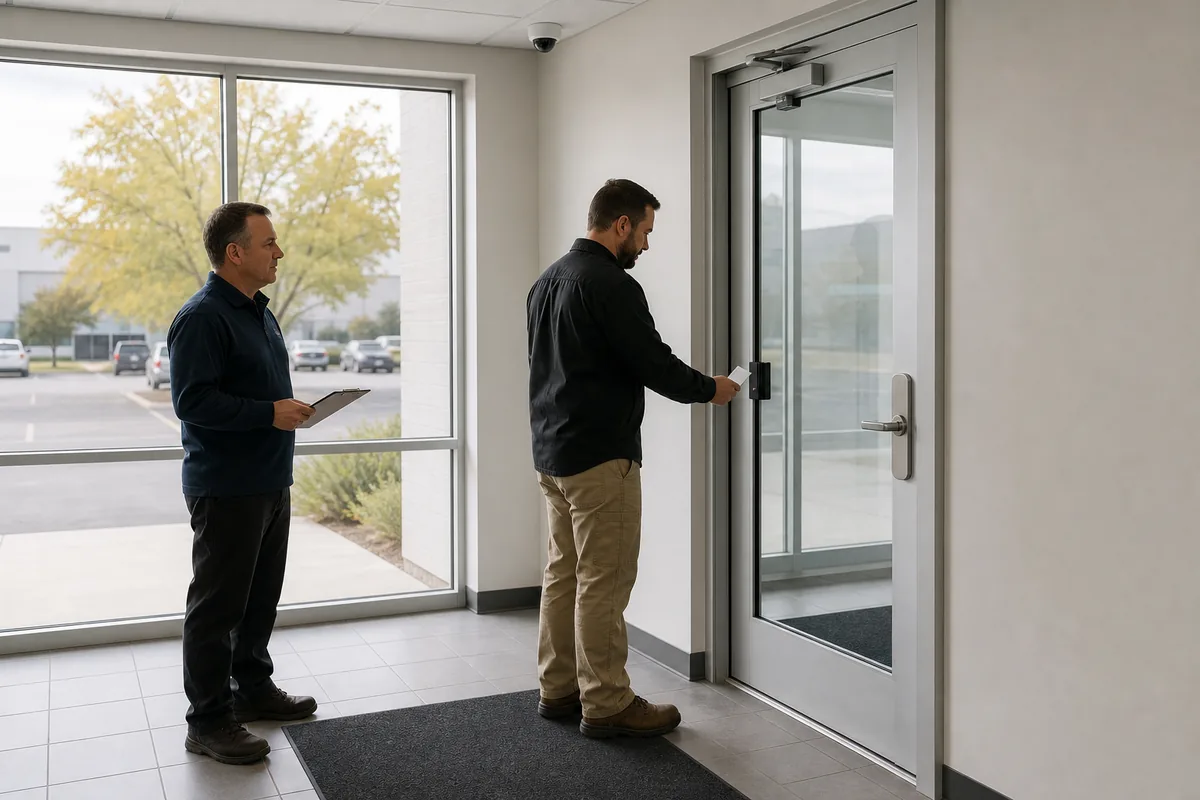
Requirement: an expired contractor credential must not release the designated service entrance and the event must be available to an authorized operator with its associated video.
Preconditions: identify the door and camera, confirm the credential has expired, use an agreed clock source, verify the approved door schedule and ensure the door is closed and secured. Keep a valid test credential available to distinguish an access-rule result from a general reader failure.
Actions: present the expired credential, observe the door, locate the event, open the linked video and export the relevant segment using the approved investigator role. Repeat the valid-credential path separately.
Expected result: the expired credential does not release the door; the system records the correct denied event and asset; the operator retrieves the intended scene and time; the authorized export plays correctly. Any required notification interval is the value agreed in the test plan.
Evidence: save the event identifier, configuration reference, test timestamps, export reference and witness result in a controlled project repository. Use synthetic test identities rather than unnecessary real personnel information.
Failure handling: log a defect if the door releases, the event is absent, the camera association is wrong or the export is unusable. Correct the cause and rerun the full case plus affected regression tests. A screenshot showing only the denial message leaves several requirements unproven.
Include faults, recovery and deferred evidence
Select fault tests from the actual architecture and risk assessment. A cloud-managed door system, local video recorder and monitored alarm can have different behaviour when connectivity fails. Ask the supplier to state expected behaviour before testing it.
Candidate scenarios include loss of a network path, recorder or storage fault, controller restart, backup-power operation, loss and restoration of a monitoring path, and recovery from an approved configuration backup. Record both the degraded state and the return to normal. Verify whether queued events arrive, time remains coherent, privileges remain correct and operators receive actionable health information.
Avoid dangerous or destructive simulations. Use a vendor-supported test method or representative environment where a live test would create unacceptable exposure. Record the limitation honestly and identify any remaining site verification.
Some evidence needs time. Configured retention is immediately inspectable; the oldest retrievable recording becomes provable only after the relevant operating period. A planned deferred test needs a date, owner, expected evidence and contractually agreed consequence. Mark it deferred, rather than declaring a pass based on a storage estimate. Seasonal lighting and occupancy-dependent scenarios require the same treatment.
Close defects with evidence and controlled retesting
Agree defect categories and acceptance consequences in advance. A practical project scheme can distinguish a stop issue affecting safety or an essential security function, a material requirement failure, and a minor documentation or finish issue. These categories are project recommendations, not universal statutory definitions.
Every defect should identify the failed requirement, observed result, evidence, impact, owner, correction, due date and retest. Where a configuration changes, assess what else could be affected. Correcting a door schedule may alter another access group; changing a camera stream may affect recording or analytics.
Keep the tested baseline identifiable. Save the accepted configuration and version inventory after corrections, then record later changes through change control. If the owner permits conditional operation, the record should state the accepted scope, unresolved exposure, temporary controls, expiry and person authorized to accept that risk. A blanket signature on an incomplete checklist obscures those decisions.
Verify handover, warranty and support separately
Ask the owner’s staff to complete representative tasks without the installer driving the interface: revoke a credential, find an alarm, retrieve a clip, contact support and locate a recovery procedure. Training attendance alone does not demonstrate operational readiness.
The handover package should include as-built drawings, asset identifiers, approved sequences, configuration backups, owner-controlled administration, licence and subscription ownership, test records, unresolved items, support contacts and recovery instructions. Store sensitive details securely and restrict access.
Check lifecycle and warranty evidence for the exact supplied products. Axis’ current support policy after discontinuation, for example, distinguishes hardware warranty from software support, warns of warranty limitations for some post-discontinuation purchases and directs customers to product-specific software support dates. It states that AXIS OS and other Axis software are not covered by the hardware warranty. Those are manufacturer-specific terms, not a market-wide promise.
Record the applicable warranty start and end dates, support status, claim route and contract responsibility for site labour, replacement configuration and retesting. Resolve missing evidence before the responsible party signs the relevant deliverable. A product warranty cannot establish that the assembled system meets the owner’s operating requirements.
Connect acceptance to payment through the contract
Have the contract administrator define how testing, defect closure, handover and payment milestones relate before award. Avoid introducing new acceptance conditions at the final invoice or assuming that any failed test permits indefinite non-payment.
Ontario’s Construction Act contains prompt-payment and holdback rules, restrictions on making proper invoices conditional on prior approval, and a specific testing-and-commissioning exception in section 6.3. Applicability and the contract’s wording matter. Obtain Ontario legal advice for payment conditions, notices and deadlines; this article supplies a technical acceptance framework, not advice to withhold payment.
The final decision record should identify accepted requirements, remaining exceptions, evidence location, handover status, configuration baseline and authorized signatures. That gives owners a clear basis for their contractual decision and future operators a trustworthy starting point.
For a new or upgraded commercial security system, Securitron Canada can help define testable operating requirements, witnessed acceptance scenarios and handover evidence before installation begins.
Frequently Asked Questions
It should demonstrate that the installed configuration satisfies the approved operational requirements. Test normal use, denied or invalid use, alarms, integrations, relevant failures, recovery and owner operation. Link each result to a requirement, asset, configuration version, expected result, witness and retained evidence.
The installer should complete and document its own checks before witnessed testing. The owner should name an acceptance authority and involve operations, security, IT and relevant specialists in tests affecting their responsibilities. The person authorized to accept contractual deliverables should review results and unresolved defects before signing.
A live image proves only part of the workflow. Confirm the required scene task under representative day and night conditions, recording, retrieval, export, timestamps, retention settings, access permissions and the response to a relevant fault. Record any condition that cannot yet be tested as deferred rather than passed.
Use the contract's acceptance process and the agreed defect categories. A conditional decision should identify exactly what is accepted, what remains unverified, compensating controls, accountable owners, deadlines and retest evidence. Unresolved safety issues or failure of an essential security function should trigger the agreed stop condition.
No. Review the manufacturer's actual coverage and exclusions separately from the integrator's installation, support and performance obligations. Record warranty dates, software support status, licences, replacement procedures and responsibility for labour, configuration restoration and retesting.