Standardizing Security Across a Multi-Site Retail Chain
Build a repeatable retail security baseline for cameras, access control, alarms, privacy, support and site exceptions across a multi-store portfolio.
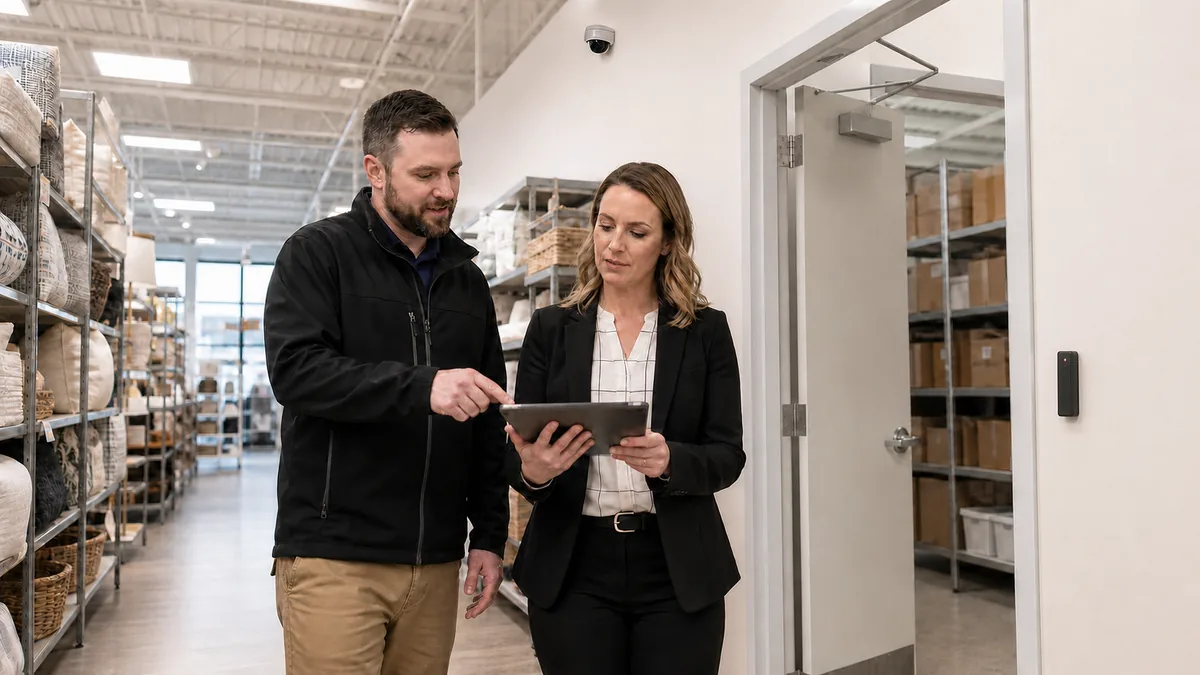
Site-by-site decisions create inconsistent evidence, access, support and cost across a retail chain. Retail operations and loss-prevention leaders should define one measurable portfolio baseline, apply it through a small set of store archetypes, and permit local variation only through documented exceptions with owners and review dates.
The baseline should specify security outcomes, user roles, naming, retention, alarm response, network controls, privacy, documentation, service and acceptance tests. Each store should also receive a site record that captures its layout, operating hours, risk assessment, lease constraints and approved deviations. This approach gives central teams comparable evidence while preserving the local conditions that affect safety and performance.
Define the standard as an operating model
A useful standard tells people what the security system must accomplish and how the organization will govern it. A corporate equipment list covers only one part of that job.
Build the standard in four layers:
- Portfolio policy: required outcomes, authority, privacy principles, cybersecurity rules, record handling and risk tolerance.
- Store archetypes: repeatable designs for common formats such as enclosed-mall stores, street-facing stores, large-format locations, outlet units and sites with exterior receiving.
- Site record: verified layout, hours, entrances, receiving workflow, high-value areas, staffing, landlord interfaces, network dependencies and current assets.
- Exception register: approved differences from the baseline, including compensating controls, ownership and review.
Assign every requirement a stable identifier. For example, VID-04 might require a retrievable overview of each public entrance, while OPS-07 might define after-hours alarm escalation. The identifier should appear in the design, proposal, test script and final evidence. This creates traceability when a store is renovated, acquired, relocated or transferred to a new service provider.
Define ownership across loss prevention, retail operations, IT, facilities, privacy, health and safety, human resources, procurement and the service provider. A centrally managed platform still needs a store-level owner for operating conditions such as blocked views, changed merchandise layouts, door problems and missed alarm contacts.
Use evidence to set priorities without treating every store alike
National data can describe a broad retail environment. It cannot determine the design for one address. Statistics Canada reported 182,361 police-reported incidents of shoplifting of $5,000 or under in 2024, equal to 442 incidents per 100,000 population and 14% above 2023, in its 2024 police-reported crime release. The release notes that online reporting may have contributed to the increase.
Those figures describe police-reported events across Canada. They exclude unreported losses, do not measure a particular chain’s shrink, and do not establish which device will improve a specific store. Use them as context for disciplined risk review. Base portfolio priorities on internal incident records, inventory and cash-loss data, safety events, alarm history, service failures, investigations and employee input.
Create a common site-risk worksheet with consistent definitions. Score factors that change the required outcome, such as:
- public entrances, emergency exits and receiving doors;
- street access, mall interfaces, parking or exterior loading;
- operating hours, lone work and closing procedures;
- cash, controlled products and high-value merchandise;
- stockroom geometry and merchandise sightlines;
- incident history and time to discover an event;
- available staffing and after-hours response;
- network, power and cellular resilience;
- lease, heritage or landlord restrictions; and
- nearby public areas that affect privacy and camera placement.
Use risk tiers to adjust the baseline through predefined options. A higher-risk site might need a second alarm communication path, broader receiving coverage, shorter response targets or more frequent health checks. Every tier change should connect to a reason and an acceptance test.
Ontario’s workplace-violence guidance identifies retail as a sector where risk may be higher and states that the assessment should be specific to the workplace. See the province’s guidance on workplace violence and harassment. A corporate template can support consistency, while each location still needs an assessment of its actual work, conditions and risks.
Build store archetypes before choosing quantities
An archetype translates the portfolio baseline into a repeatable starting design. It should describe zones, workflows and required evidence instead of imposing one camera count on every floor plan.
| Store archetype | Typical characteristics | Standardization focus | Likely local variables |
|---|---|---|---|
| Enclosed-mall store | Shared mall corridors, landlord service route, limited exterior exposure | Mall opening and closing, public entrance, stockroom transition, landlord contacts | Mall rules, service-door ownership, ceiling and cabling restrictions |
| Street-facing store | Direct public entrance, glazing, nearby sidewalk and possible rear delivery | Entrance evidence, after-hours perimeter, public-area privacy, rear-door response | Street geometry, exterior lighting, neighbouring premises |
| Large-format retail | Multiple entrances, wide sales floor, receiving and higher device count | Zone naming, distributed recording, receiving workflow, health monitoring | Ceiling height, departments, parking, loading operations |
| Compact or kiosk format | Small footprint, limited back-of-house space, landlord infrastructure | Focused purpose, minimal collection, secure equipment location | Shared concourse, storage access, available network and power |
| High-value or controlled merchandise | Concentrated product risk and restricted storage | Layered authorization, investigation quality, access logs | Product handling, staffing, regulatory or insurer requirements |
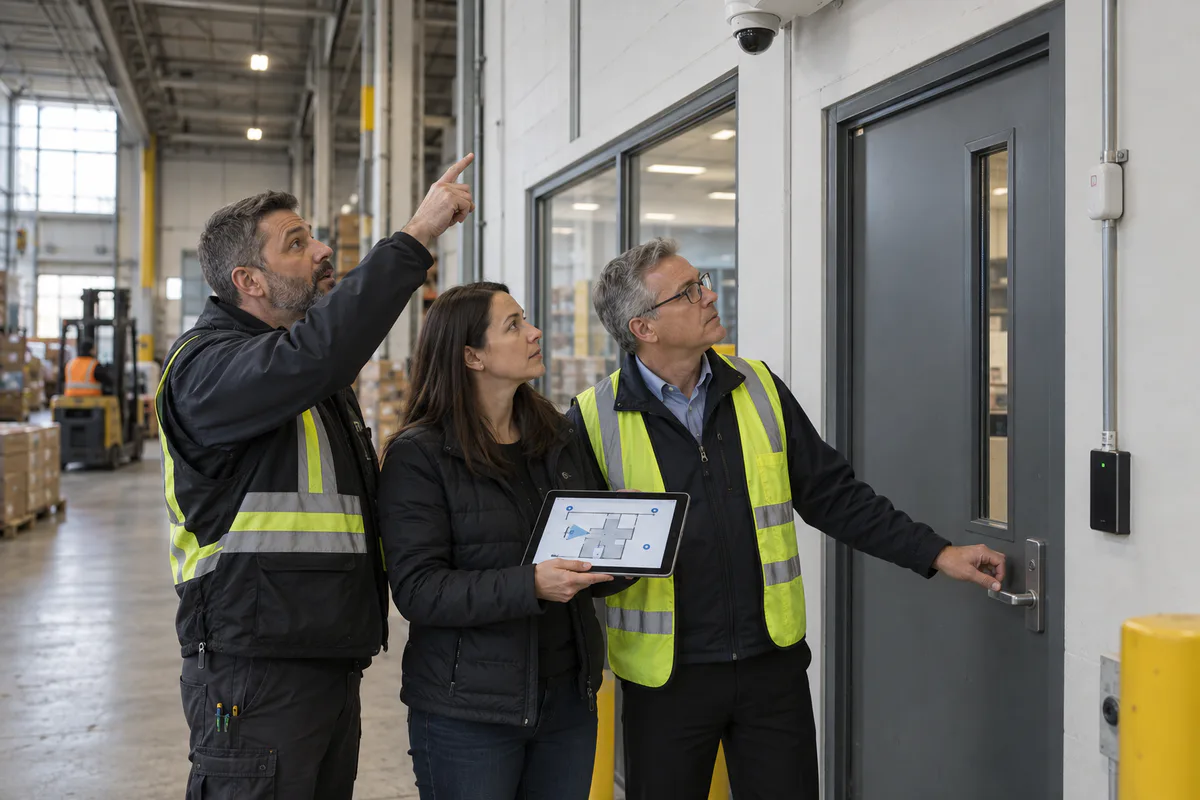
For each archetype, create a reference zone diagram, approved device families, network pattern, role model, alarm matrix, documentation set and test plan. The archetype remains a starting point. The site survey must confirm fields of view, door operation, lighting, cabling, power, mounting surfaces, network reach, emergency egress and service access.
Store changes can invalidate an approved design. Seasonal displays, queue barriers, fixtures and promotional structures can block views or affect travel paths. Require retail operations to include security and egress checks in the change process for material floor-plan modifications.
Specify a baseline that produces comparable evidence
The baseline should make one store understandable to a person who normally works at another. Standardize the information architecture as carefully as the devices.
Video surveillance
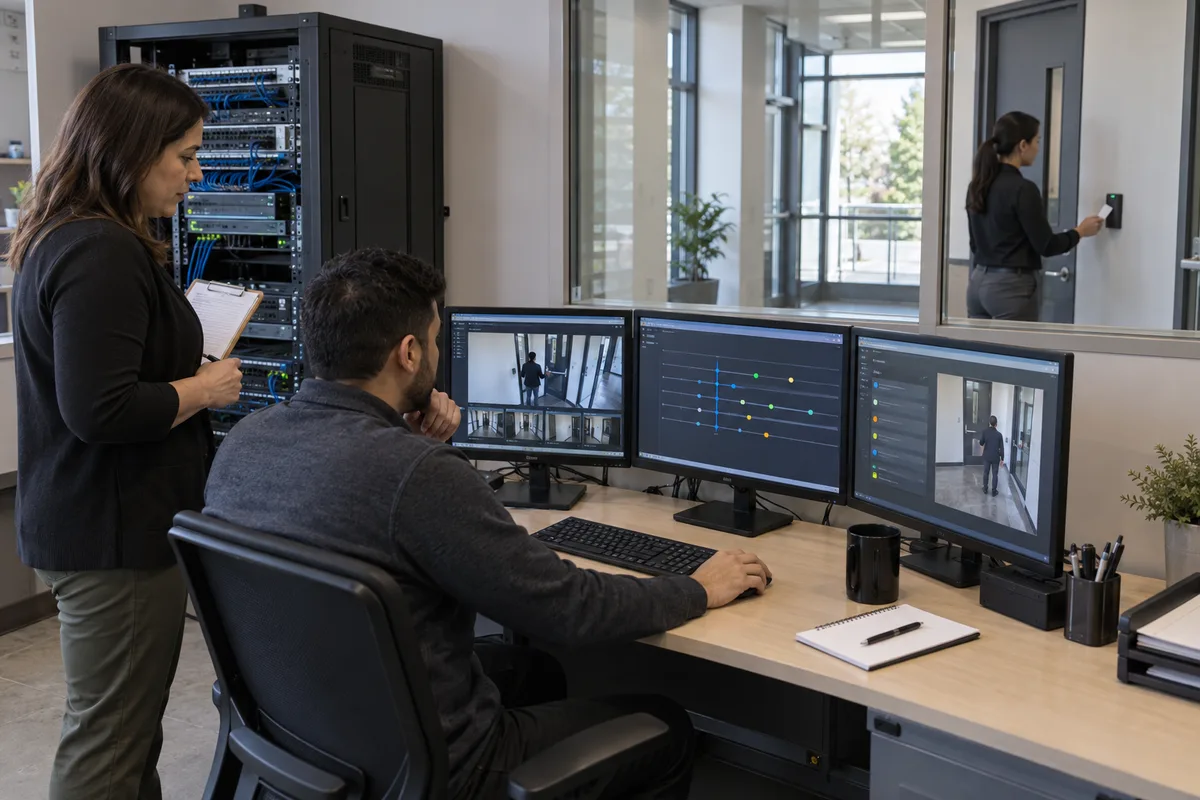
Define camera purpose by zone, expected subject size or decision, lighting condition, retention, frame rate, time synchronization, privacy mask, health alert, export method and role access. Use a naming convention that identifies region, store, zone and view without exposing sensitive detail to unauthorized users.
The Office of the Privacy Commissioner of Canada’s private-sector video surveillance guidelines recommend establishing a business reason, limiting fields of view and collection, informing people, securing recordings, restricting access, documenting disclosure and destroying recordings when no longer required. The guidance dates from 2008 and applies to overt surveillance of the public under identified private-sector privacy laws. Employee monitoring, covert surveillance and provincial requirements need separate legal and policy review.
Use standards claims precisely. ONVIF Profile T defines IP-video capabilities including H.264 and H.265 streaming, imaging settings, motion and tampering events, metadata and conditional functions. A conformant product may still vary in conditional features, analytics and vendor-specific behaviour. Record required functions and test the exact camera, firmware, recorder and client combination.
Access control and doors
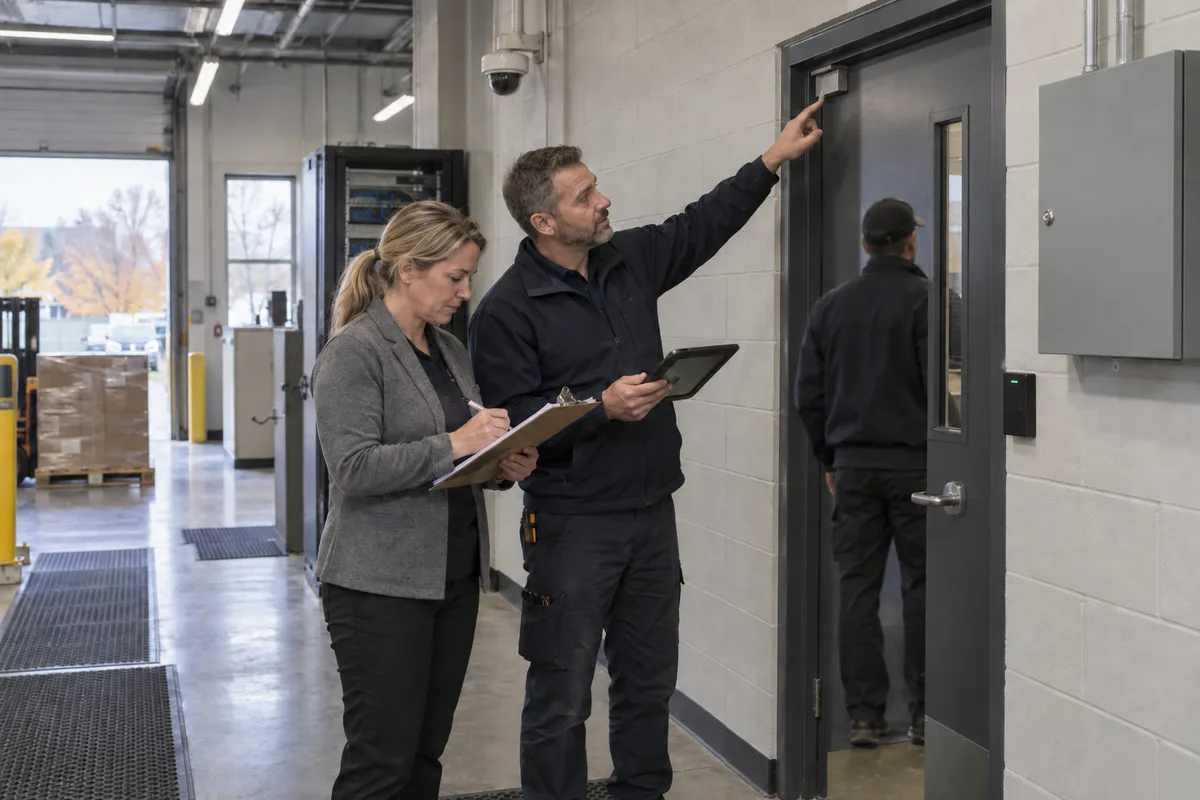
Standardize credential lifecycle, role groups, schedules, holiday handling, forced and held-door events, remote unlock authority, emergency procedures, logging and offboarding. Keep site-specific door hardware, egress, accessibility and landlord interfaces visible in the design record.
The Ontario Fire Code, O. Reg. 213/07 includes retail-specific provisions for checkout counters and access to exits. Section 2.7.2 also addresses door release hardware, inside egress and electromagnetic locking conditions. The current code, approved design and authority having jurisdiction must be confirmed for each affected door. A portfolio technology standard does not decide code compliance for a particular opening.
For reader-to-controller communication, the Security Industry Association describes OSDP as a bidirectional and supervised access-control protocol with Secure Channel support. Product support, verified status, secure configuration and interoperability still require confirmation for the proposed models and firmware.
Intrusion alarms and response
Define zone naming, arming partitions, authorized users, duress procedures, opening and closing rules, communication paths, monitoring-centre instructions, call lists, false-alarm review and service tests. Maintain a municipality and police-policy field because response, registration and cost-recovery rules can vary across a GTA portfolio.
Network, identity and support
Set approved network zones, addressing, DNS and time sources, encryption, remote-access paths, administrator authentication, logging, firmware ownership, backup, restore, cloud dependencies and vendor offboarding. Use portfolio roles such as store manager, district manager, loss prevention investigator, system administrator and service technician, then limit each role by site and function.
These controls should connect to the chain’s broader multi-site retail security planning so store operations, infrastructure and support follow one governed model.
Standardize the operating procedures around the systems
Consistent devices still produce inconsistent outcomes when store teams follow different procedures. Write short operating playbooks for the events that matter.
At minimum, cover:
- opening, closing and failed-to-arm escalation;
- employee, manager and contractor credential changes;
- alarm acknowledgement, verification and dispatch communication;
- video review, export, preservation, disclosure and chain of custody;
- workplace violence or threatening behaviour escalation;
- power, network and device outage response;
- temporary construction, fixture moves and camera obstruction;
- service-provider access and change control;
- former employee and vendor offboarding; and
- incident closure, lessons learned and standard updates.
Define the required record and owner for every procedure. A store manager may acknowledge a local problem, the central loss-prevention team may decide whether to preserve video, IT may restore a network dependency, and the integrator may repair a device. One incident record should show the handoffs and final verification.
Train by role. Store staff need clear actions for opening, alarm trouble, blocked cameras and safe escalation. Investigators need search, export, privacy and evidence-handling instruction. Administrators need account, configuration, remote-access and audit responsibilities. Repeat training after major platform or policy changes and retain completion evidence.
The chain’s existing retail loss-prevention guidance can support broader staffing, merchandising and incident-response decisions. The security standard should turn the selected policies into repeatable system behaviour and testable store procedures.
Control exceptions as managed risk decisions
Exceptions allow the standard to survive real buildings and operations. An informal deviation creates hidden support and evidence gaps. A controlled exception explains the difference and how the risk will be handled.
Each exception should contain:
| Field | Required record |
|---|---|
| Baseline requirement | Identifier and expected result |
| Site condition | Verified fact preventing or changing compliance |
| Consequence | Security, safety, privacy, operational and support effect |
| Compensating control | Alternative measure and responsible operator |
| Approval | Accountable business, technical and specialist roles as applicable |
| Duration | Start, expiry or permanent-review classification |
| Evidence | Drawing, photograph, test, configuration or service record |
| Review trigger | Renovation, incident, lease change, failure, upgrade or scheduled date |
Common examples include a heritage surface that prevents a preferred cable route, a landlord-controlled service corridor, unavailable network connectivity, a camera purpose that would capture excessive public space, legacy door hardware awaiting a planned retrofit, or a store layout that requires a different camera family.
Track exception age, overdue reviews and repeated patterns. If many stores need the same exception, the baseline may be unrealistic or an archetype may be missing. Update the standard through change control, preserving the rationale, version and affected-site plan.
Roll out the standard in controlled waves
Begin with discovery. Reconcile the site list, platforms, licences, administrators, vendors, remote-access methods, device inventory, retention, alarm accounts, network dependencies, documentation and known deficiencies. Label every fact as verified, reported or unknown.
Choose pilot stores that expose meaningful variation. A useful pilot set might include one mall location, one street-facing location and one site with receiving or higher-value inventory. Avoid selecting only the cleanest and newest stores.
Use this sequence:
- approve the policy, archetypes, roles, requirement IDs and exception method;
- survey pilot sites and verify hidden dependencies;
- build the reference configuration and evidence package;
- test normal, invalid, failure and recovery cases;
- correct the baseline where pilot evidence exposes a portfolio issue;
- deploy in waves grouped by architecture, region or service readiness;
- close each site with complete acceptance evidence; and
- review portfolio metrics before the next wave.
Plan legacy coexistence. Define which central functions must work during transition, how mixed naming and roles will be reconciled, and when old accounts, applications, licences, firewall rules and service contracts will be removed.
Acceptance tests should prove the portfolio outcome
Use the same test identifiers and result format across every location. Adapt the setup to local equipment without weakening the required outcome.
Ask the implementation team to demonstrate:
- every required entrance, transaction, high-value or receiving view supports its documented decision under day and representative low-light conditions;
- approved users can see only their assigned stores and functions;
- a disabled or expired user cannot enter the platform or controlled area;
- recording retention, export, timestamps and privacy controls match the approved site record;
- forced-door, held-door, alarm, trouble and communication-path events reach the correct queue and contact;
- loss of a required camera, recorder, controller, alarm path or network dependency creates the expected health response;
- remote service follows the approved identity, authorization, logging and closure process;
- doors and locking functions pass the applicable qualified safety and egress checks;
- configuration backup, restoration and administrator transfer succeed; and
- every deviation appears in the signed exception register with a current disposition.
Capture the store, asset, requirement, configuration version, tester, date, expected result, observed result, evidence, deficiency owner and retest. A signed summary without test-level evidence makes later comparison difficult.
Measure conformance and operational value
Use measures that prompt action:
- percentage of stores with current site records and verified asset inventories;
- baseline requirements passed, failed and excepted by archetype;
- open exceptions by age, owner and risk;
- critical cameras, doors and alarm paths with current health data;
- time from security-system fault to acknowledgement and verified restoration;
- failed-to-arm, false-alarm and repeated device-fault patterns;
- users with broader access than their current role requires;
- investigations with usable video and synchronized timestamps;
- stores with overdue privacy, retention, credential or alarm-contact reviews; and
- recurring field substitutions or deficiencies that indicate a weak baseline.
Compare like stores and explain material differences. A higher incident count can reflect greater exposure, better reporting or a temporary condition. Use several measures and local context before changing a risk tier or investing in new controls.
Review the standard at a fixed interval and after material events. Triggers include a serious incident, new store format, acquisition, platform change, privacy change, code change, repeated support failure or a pattern of exceptions. Record the reason for each revision and the stores that need remediation.
Questions to ask vendors before portfolio approval
- Which outcomes, configurations and documents will be identical across stores?
- Which decisions require a site survey, risk assessment or qualified door review?
- How will platforms, device families, firmware and licences be supported over the portfolio lifecycle?
- Can user roles be limited by region, store and function through the organization’s identity process?
- How will naming, time, retention, alarm routing and health thresholds be provisioned and audited?
- Which ONVIF, OSDP or other standards claims apply to the exact models, versions and functions proposed?
- How will privacy purpose, fields of view, audio, access, export and retention be documented per site?
- What central functions continue during internet, cloud or wide-area network failure?
- How are substitutions, temporary workarounds and permanent exceptions approved and reported?
- What evidence will prove each store meets the baseline before acceptance?
A strong multi-site standard gives retail leaders one dependable way to define, deploy, test and support security while keeping local risk decisions visible. Securitron Canada can help turn portfolio requirements and store surveys into a practical baseline, exception register and commissioning plan for retail locations across the GTA.
Frequently Asked Questions
Use an approved platform, supported device families and common configuration rules where they fit. Camera types, quantities, door hardware and alarm points should still reflect the store layout, risk, lease conditions and operating workflow. Record approved variations in a controlled exception register.
Define required security outcomes, store archetypes, camera and door naming, user roles, retention rules, alarm routing, network and cybersecurity controls, privacy requirements, documentation, health monitoring, service levels and acceptance tests. Assign an owner and evidence requirement to every mandatory control.
Record the requirement, site condition, reason, risk, compensating control, approver, owner, review date and expiry or permanent disposition. Reassess the exception after renovations, incidents, lease changes, system upgrades or material operating changes.
Use the same evidence package at every site: approved design, asset register, configuration export, labelled images or views, role review, alarm and health tests, privacy checks, training record, open deficiencies and signed acceptance results. Compare conformance and exceptions without reducing performance to a device count.