Enterprise Security Integration Roadmap
Integrate cameras, access, alarms, intercom, visitor, and operations systems through governed events, clear ownership, staged testing, and resilient workflows.
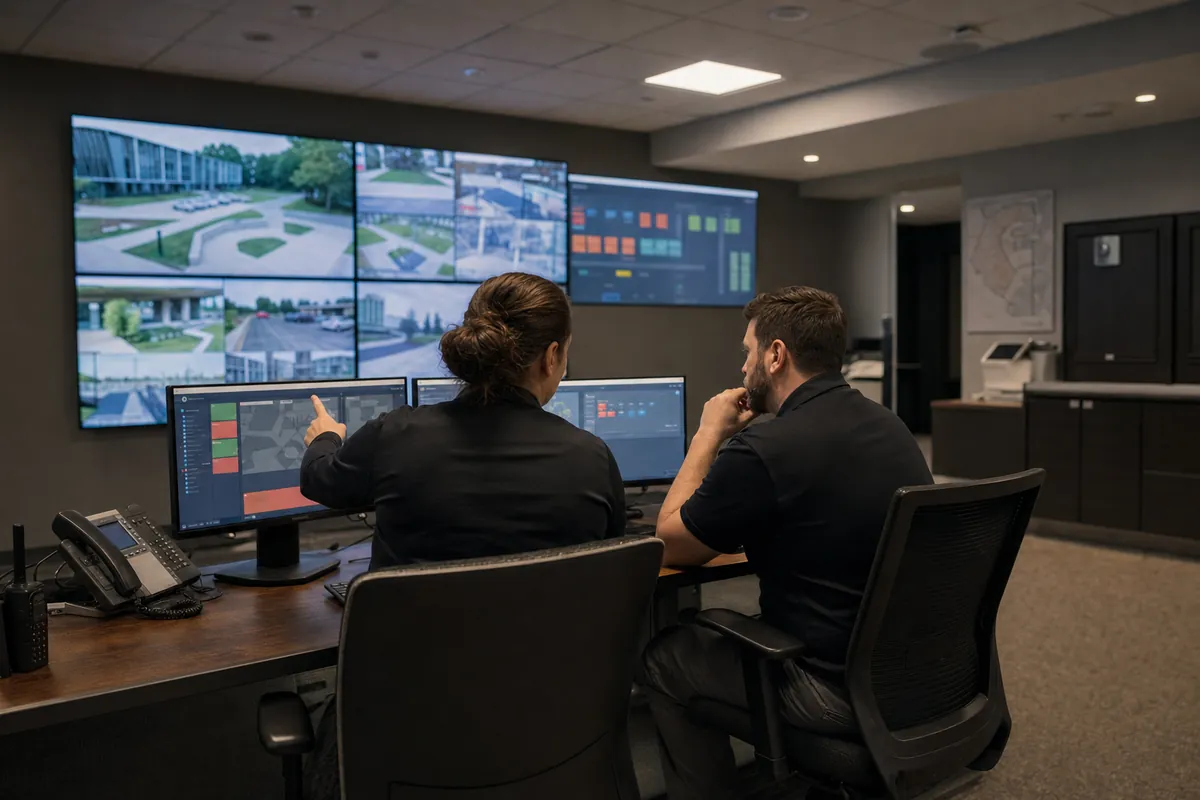
Integration is valuable when it removes delay or ambiguity from a real workflow. It is harmful when a web of undocumented dependencies makes several systems fail together.
An enterprise roadmap should move from isolated but understood products to governed, observable workflows in deliberate stages.
Phase 1: Inventory Systems and Owners
Create a service catalogue for cameras, video management, access control, intrusion, intercom, visitor management, identity, building systems, monitoring, notification, and relevant operational platforms.
For each service, record:
- business and technical owner;
- sites, users, and critical workflows;
- authoritative data it creates;
- inbound and outbound integrations;
- hosting, network zones, and remote dependencies;
- identity and administrator model;
- version, support status, licences, and contracts;
- backup, recovery, and degraded operation;
- known data quality and time issues.
Do not begin with architecture diagrams that imply certainty. Validate integrations against configurations, logs, and owner interviews.
Phase 2: Select Workflows by Value
Use event stories to prioritize:
When a forced door occurs at a staffed facility, the operator receives the door identity, live and pre-event video, credential context, and a response instruction within a defined time.
Score each candidate by risk reduction, frequency, operator effort, data readiness, technical complexity, privacy impact, and failure consequence. High-value, bounded workflows make better first integrations than a universal “single pane of glass.”
Phase 3: Define Data and Authority
For every object—person, credential, door, camera, site, alarm, visit, vehicle—choose the authoritative source and a stable identifier. Document how updates propagate and how conflicts are resolved.
Important questions include:
- Which system decides whether access is allowed?
- Which system owns a person’s status?
- Which timestamp is authoritative?
- What happens when a site or door is renamed?
- Are duplicate or replayed events safe?
- Can an integration command unlock or only display?
- Who approves a change to that authority?
Read-only context is lower risk than cross-system control. Add control functions only where the operational benefit justifies stronger authentication, authorization, logging, and testing.
Phase 4: Design for Failure
Essential local functions should not depend unnecessarily on the integration layer. Doors should follow their approved local behaviour, recorders should continue recording, and alarms should retain a response path according to the risk design.
For each dependency, define timeout, retry, queue, duplicate handling, offline cache, alert, recovery, and reconciliation. Display degraded status to operators. A blank context panel must not look like “no risk.”
Apply least privilege between services. NIST’s Zero Trust Architecture describes eliminating implicit trust based only on network location. In practice, give an integration identity only the API scopes, sites, commands, and data it requires, then log its activity.
Phase 5: Build an Event Contract
An event contract defines more than a payload. Include:
- source and event type;
- stable object IDs and human-readable labels;
- event and receipt timestamps;
- severity and state transitions;
- acknowledgement and closure;
- related video or access context;
- privacy classification;
- retention and audit requirements;
- retry, ordering, and duplicate behaviour;
- versioning and change notice.
Use representative test events, including missing fields, delayed messages, duplicate messages, clock drift, renamed assets, and disconnected endpoints.
Phase 6: Design the Operator Experience
Operators need prioritized work, not more windows. For each alarm, show the essential context, recommended action, communication path, and acknowledgement state. Suppress cascades where one physical condition creates many technical events, but retain the underlying audit trail.
Test with actual operators. Count clicks, window changes, information searches, and decision time. Confirm accessibility, screen readability, and handoff between shifts.
Phase 7: Pilot and Measure
Choose one site and one or two workflows. Establish baseline measures before integration, such as assessment time, false dispatches, incomplete investigations, or manual data entry.
Test normal, invalid, after-hours, network-loss, source-system-loss, integration-loss, delayed-event, and recovery scenarios. Run the pilot long enough to see ordinary operational variation, then compare results with the baseline.
Phase 8: Govern the Lifecycle
Create an integration register with owner, purpose, data, permissions, version, certificate or secret, support path, monitoring, test evidence, and retirement plan. Review it when source systems update.
Define change environments, release approval, rollback, credential rotation, certificate expiry alerts, vendor remote access, vulnerability handling, and annual failure tests.
The goal is not to make every system dependent on every other system. It is to deliver a small number of clear, resilient workflows that help people assess, decide, respond, and learn faster.
Frequently Asked Questions
Start with a high-frequency or high-consequence workflow where linking events clearly improves response, such as forced-door alarms presenting relevant video. Avoid integrating everything before ownership and expected behaviour are defined.
Each source system should retain its essential local control, integrations should fail visibly, time and identities should be consistent, retries and duplicate events should be handled, and operators should have a tested degraded procedure.
Measure operational results such as time to assess an alarm, steps per investigation, false dispatches, unresolved events, data reconciliation, and recovery from failure—not only whether an API connection is online.