Logistics Yard and Gatehouse Security for Mississauga and Brampton
Improve logistics yard control with appointment-aware entry, layered vehicle verification, driver safety, gatehouse workflows, and auditable exceptions.
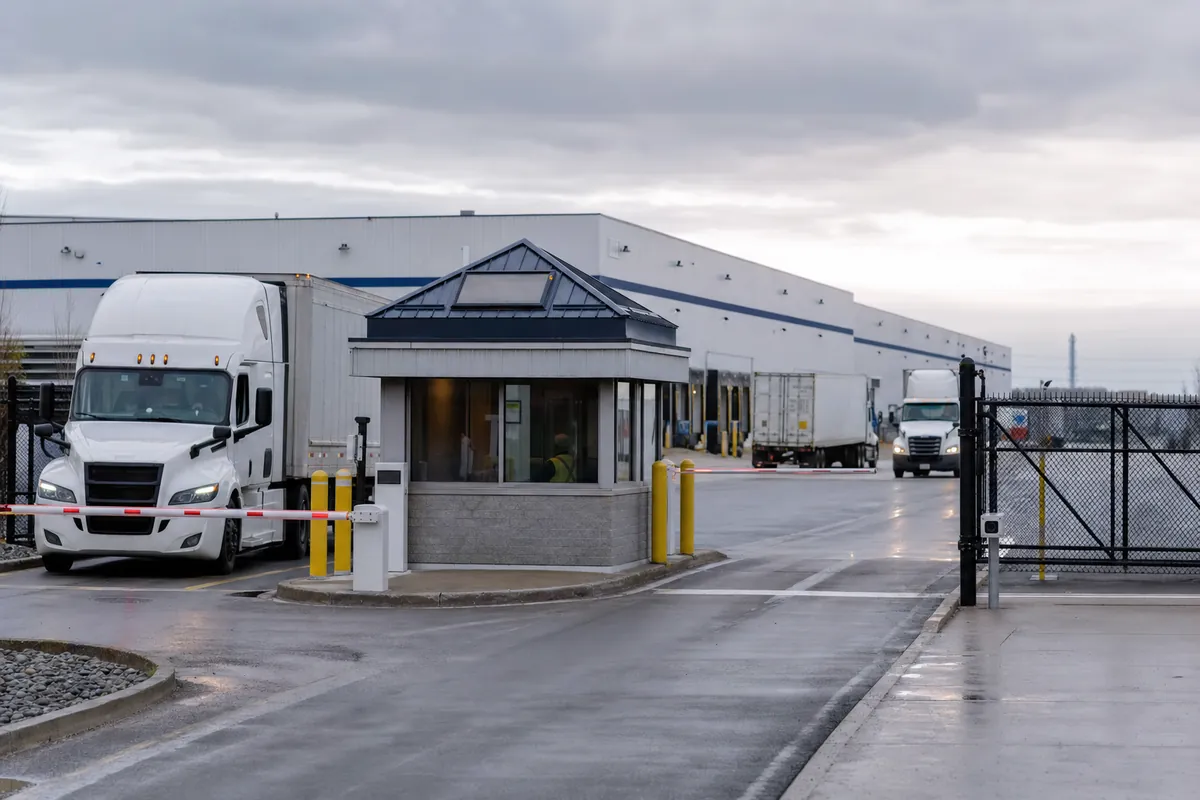
A logistics gate is where digital authorization meets a physical vehicle, a driver, a trailer, and a time-sensitive operation. When these elements are not reconciled, the gatehouse becomes either a bottleneck or a weak control.
Map the Vehicle Journey
Document every stage from public road to exit:
- appointment or pre-authorization;
- approach and safe queue;
- driver communication;
- identity, carrier, vehicle, and trailer verification;
- gate decision and exception approval;
- yard routing and waiting;
- dock or drop assignment;
- trailer or seal change;
- outbound authorization;
- exit record.
Identify where custody, liability, or congestion changes. Those points deserve stronger process evidence than a generic wide camera.
Separate Authentication From Authorization
Recognizing a plate or credential does not prove the current visit is authorized. Build the decision from several signals appropriate to the risk:
- current appointment or dispatch reference;
- approved carrier and vehicle;
- driver credential or verified identity;
- trailer and load relationship;
- destination and time window;
- previous entry or anti-passback state;
- exception approval by a named role.
Define which mismatches cause denial, secondary review, or supervised entry. Operators should not invent rules during a traffic surge.
Design Safe Lane Geometry
Technology cannot repair unsafe circulation. Confirm queue length, turning radius, sightlines, pedestrian separation, gate setback, barrier-arm visibility, height clearance, drainage, snow storage, and emergency access.
Place readers, intercoms, cameras, and call stations where a driver can use them without leaving a safe position or striking equipment. Protect devices with suitable islands and bollards without creating a new collision hazard. Engage qualified civil, traffic, and safety professionals for the physical design.
Use Complementary Camera Views
A useful lane often needs several different views:
| View | Purpose |
|---|---|
| Approach overview | Queue, direction, and context |
| Plate or vehicle detail | Vehicle evidence at a controlled point |
| Driver interaction | Gate transaction and exception handling |
| Trailer or seal | Cargo-custody evidence where required |
| Yard overview | Route, parking, and incident reconstruction |
| Exit | Outbound vehicle and authorization context |
Control glare from headlights, reflective plates, wet pavement, snow, and gatehouse glass. Test day, night, rain, and winter conditions. Do not assume an analytics demonstration represents every vehicle type or plate condition.
Build an Exception Workflow
Common exceptions include early or late arrival, changed tractor, changed trailer, missing appointment, unreadable plate, contractor vehicle, disabled credential, emergency service, and network outage.
For each exception, define evidence required, approval role, temporary permission, lane action, record, and follow-up. Measure exception volume: repeated exceptions often reveal upstream scheduling or data quality problems.
Integrate Systems Carefully
Gatehouse, access control, yard management, video, intercom, intrusion, and visitor systems may exchange events. Document the authoritative source for appointment, identity, gate state, and final transaction.
Synchronize time across platforms. Use a stable transaction or visit ID so operators and investigators can retrieve related events without guessing. When one integration fails, show an explicit degraded state rather than silently accepting incomplete data.
Protect Privacy and Data
Gate systems can collect images, names, credentials, vehicle details, visit history, and communications. Define purpose, fields collected, user roles, retention, disclosure, and deletion for each category.
The Office of the Privacy Commissioner of Canada recommends limiting surveillance to a defined need, providing notice, restricting access, securely storing recordings, and destroying them when no longer required. Apply those principles to video and the broader gate transaction record, with qualified privacy advice.
Plan Degraded Operation
Test loss of WAN, local server, cloud service, reader, intercom, camera, lane controller, and utility power. Decide:
- whether the gate remains secured or moves to staffed manual operation;
- which authorizations remain available locally;
- how emergency and life-safety access works;
- where manual records are kept and protected;
- who is notified;
- how transactions are reconciled after recovery.
Run the test during representative traffic before relying on the procedure.
Measure Operations
Useful measures include transaction time, queue length, exception rate, denied-entry reason, manual overrides, equipment faults, after-hours approvals, alarm acknowledgement, and unresolved access records. Review the measures with operations, transportation, security, and IT together.
A strong gatehouse control system accelerates normal authorized traffic because data and rules are prepared. It spends human attention on exceptions, not on re-entering information that another system already knew.
Frequently Asked Questions
Verification should match site risk and policy, typically appointment or authorization, carrier and vehicle, driver identity or credential, destination, arrival time, and exception approval. Collect only information that has a defined purpose and retention rule.
A plate is one signal, not complete authorization. Use it with appointment, carrier, driver, trailer, credential, and operator rules according to risk. Define how unreadable, missing, temporary, or mismatched plates are handled.
Document which lanes continue, what information is cached, how gates are operated safely, how manual records are protected, and how events are reconciled later. Test the degraded workflow during realistic traffic.