How to Plan a Commercial Camera Coverage Survey
Plan a commercial camera survey around evidence goals, privacy, lighting, pixel density, obstructions, infrastructure and acceptance tests.
A commercial camera survey should answer a business question before it answers a hardware question. If a loading-door incident occurs, what must the recording prove? If someone presents a credential at a controlled entrance, does the organization need an overview of the event, recognizable characteristics, or detail suitable for identification? If a vehicle crosses a gate, which direction, lane and lighting condition matter?
Those questions determine whether a proposed view is useful. Starting with a camera count, megapixel specification or generic floor-plan icon can create apparent coverage while leaving the decisive moment unrecorded. The practical goal of a survey is therefore not to cover every square metre. It is to produce a defensible view schedule: each planned view has a purpose, a required level of detail, operating constraints and an acceptance test.
Executive summary: what the survey must deliver
A decision-ready survey should leave facilities and loss-prevention leaders with five concrete outputs:
- a list of incidents and operational questions the system must support;
- a marked-up plan showing required scenes, subjects, directions and privacy boundaries;
- a view schedule defining the detail and conditions required at each location;
- infrastructure, storage and operational assumptions that affect cost; and
- acceptance tests that can be repeated before the project is signed off.
This process belongs ahead of equipment selection. It may confirm that an existing camera can be repositioned, that lighting or a physical control is more important than another camera, or that one broad view must be divided into an overview and a tighter evidentiary view.
1. Convert concerns into observable events
Interview the people who experience the problem: receiving supervisors, property managers, investigators, IT, health and safety, privacy, and after-hours responders. Ask for recent event types rather than assumptions about where cameras “should” go.
Useful event statements are specific and observable:
- a trailer arrives at the wrong dock or outside its appointment window;
- an emergency exit opens without an approved reason;
- a person follows an authorized user through a controlled door;
- inventory changes custody between receiving and secure storage;
- a vehicle damages property and leaves through one of several routes;
- an investigator needs to reconstruct movement between two zones.
For every event, record the subject, direction of travel, likely distance, expected speed, time conditions, common obstructions, discovery delay and person responsible for response. Also record what the organization does not need to collect. The federal Office of the Privacy Commissioner’s guidance for overt private-sector video surveillance recommends establishing the business reason, considering less privacy-invasive alternatives and limiting camera viewing range. That makes purpose definition part of the survey—not a policy exercise postponed until after installation.
2. Assign an evidence objective to every view
“See the loading area” is not a testable requirement. “Determine whether a person entered the closed dock doorway” and “identify the person who presented at the employee entrance” are different objectives and demand different detail.
An IEC-derived planning model groups human-viewed video into four practical levels. Axis’s current pixel-density guidance based on IEC 62676-4:2014 lists approximately:
| Operational objective | Guideline pixel density | What the view is intended to support |
|---|---|---|
| Detection | 25 pixels per metre | Determine that a person is present |
| Observation | 63 pixels per metre | Understand activity and visible characteristics |
| Recognition | 125 pixels per metre | Assess whether a person is someone previously seen |
| Identification | 250 pixels per metre | Capture detail intended to support identification |
These figures are planning guidelines, not guarantees. The same source cautions that light direction, optics and compression affect the result, and that analytics and thermal applications use different criteria. Treat pixel density as a measurable starting point. Validate the actual scene with the proposed camera, lens, settings, recorder and viewing workflow.
A common design pattern is to pair two objectives: an overview explains what happened, while a tighter view at a natural choke point captures the necessary detail. Asking one ultra-wide camera to identify a subject across a deep scene is usually a budget illusion.
3. Survey the scene under operational conditions
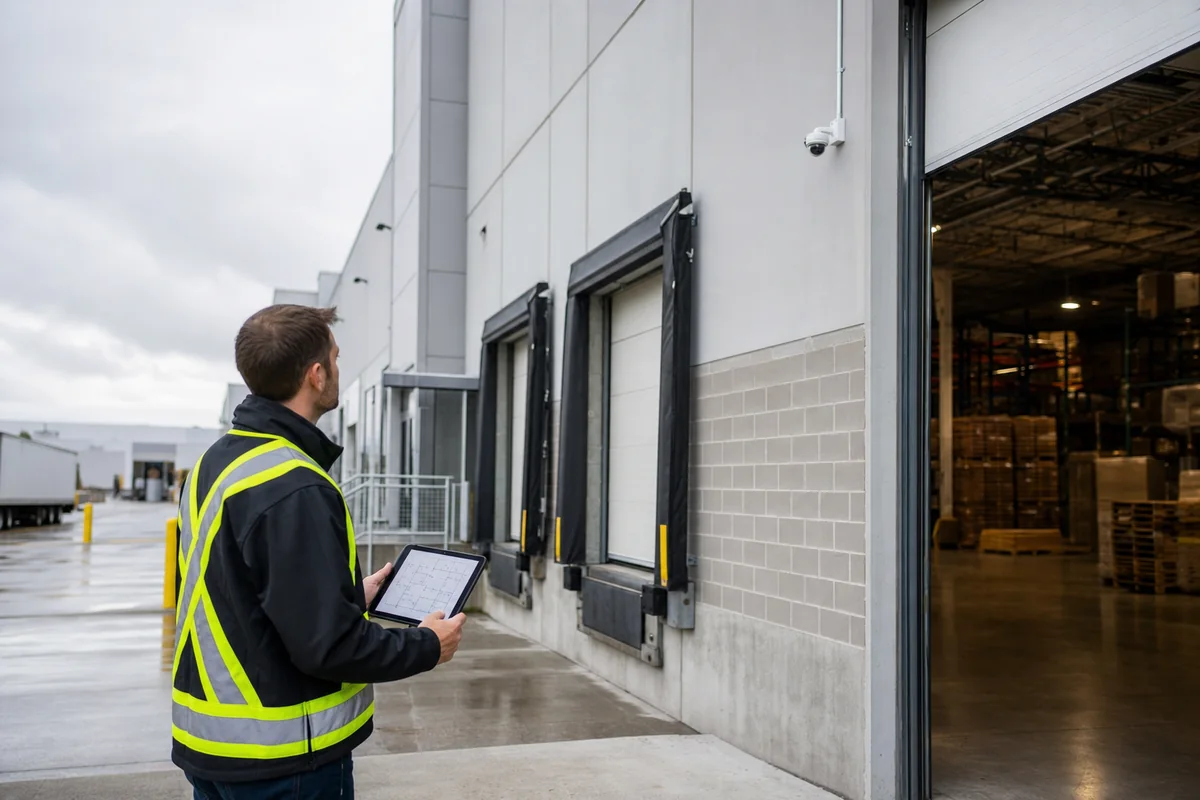
The person conducting the survey should walk the site with a current plan and photograph proposed scenes from approximately the intended mounting positions. Measurements should include mounting height, target distance, scene width at the target, subject direction and physical access for installation and maintenance.
Record conditions that can invalidate an otherwise attractive image:
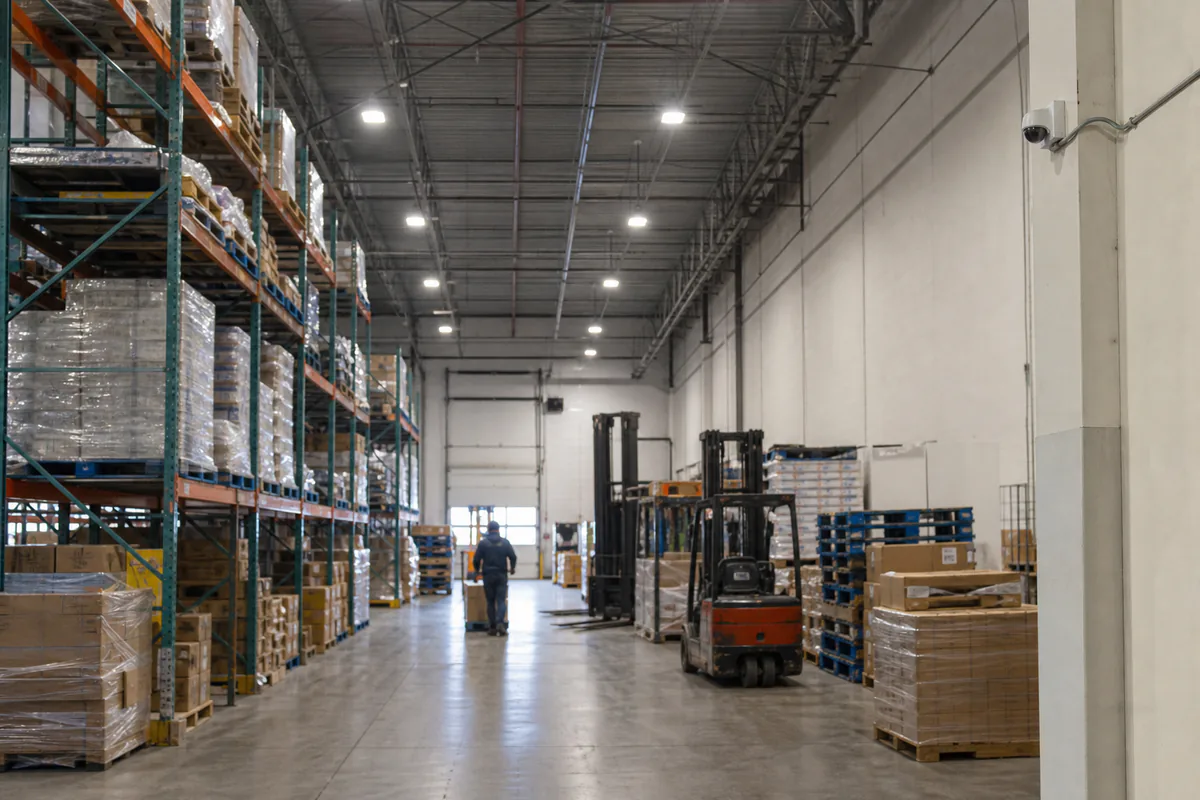
- trucks, racks, displays, vegetation or seasonal material blocking sightlines;
- open dock doors creating severe backlight;
- reflective wrap, wet pavement, glass or polished surfaces producing glare;
- changing sun angles and exterior lighting schedules;
- fast lateral movement near the edge of the frame;
- steam, dust, vibration, cold or wash-down conditions;
- future construction, racking or tenant improvements;
- lifts or ladders required for safe service access.
An empty-site walkthrough is not representative for a working warehouse, retail property or multi-tenant building. Where possible, revisit critical scenes during peak operations and darkness. If that is impossible before design approval, label the unobserved condition as an assumption and make nighttime or operating-condition validation a commissioning requirement.
4. Match field of view, lens and depth—not megapixels alone
Resolution describes the total image. The lens and scene determine where those pixels land. According to Axis’s technical paper on lenses in surveillance, field of view depends on lens focal length and sensor size; longer focal lengths create narrower views, while depth of field is also affected by focal length, aperture, subject distance and viewing conditions.
For each proposed view, the survey should therefore document:
- required scene width at the subject plane;
- closest and farthest useful subject distances;
- required pixel density at the decisive point;
- whether focus must remain useful across a deep area;
- whether a fixed or adjustable lens is appropriate; and
- where perspective or mounting angle may hide faces, hands, plates or transactions.
Do not use digital zoom in a sales demonstration as evidence that the underlying recording contains sufficient detail. The acceptance test must use exported recorded footage at the expected bitrate and compression—not merely a live view on the installer’s laptop.
5. Treat lighting as part of the security design
Camera performance depends on the light reaching the sensor, not simply on a low-light number in a datasheet. Axis’s lighting guidance for network video explains that image performance depends on the quantity, quality and distribution of light. It also notes that uneven illumination and bright points can reduce useful nighttime performance.
During the survey, test or document:
- the darkest normal operating condition;
- strong backlight from entrances, dock doors and vehicle headlights;
- whether exterior fixtures switch off or change output overnight;
- the width and distance of white-light or infrared illumination;
- reflective objects that may dominate exposure;
- whether colour is operationally important; and
- whether added light would create glare, nuisance or privacy concerns.
Lighting and field of view must be designed together. A narrow illuminator inside a wide camera view may create a bright centre and dark edges; light that is wider than the scene wastes energy and may affect neighbouring property. Representative moving footage is the appropriate test because motion blur, exposure and compression interact.
6. Draw privacy boundaries before drawing coverage cones
The survey should mark areas the system must avoid or minimize: neighbouring property, residential windows, public areas unrelated to the purpose, computer screens, private treatment or change spaces, and employee areas where a separate legal or policy assessment may be required.
The federal private-sector guidance calls for limited viewing range, notice, controlled access, secure storage and destruction when recordings are no longer needed. Ontario’s Information and Privacy Commissioner video-surveillance guidance is directed to public-sector institutions and is currently flagged for review following 2026 legislative changes; it remains a useful source of governance questions, but it should not be presented as private-sector legal advice.
Add privacy requirements to the drawing and view schedule:
- the documented purpose for each camera;
- privacy masks or physical limits;
- whether audio and advanced analytics are disabled;
- notice locations before individuals enter the surveyed area;
- roles permitted to view, export or administer video;
- retention and secure deletion ownership; and
- a process for access, preservation and disclosure requests.
Legal obligations vary by organization and context. The survey should identify where privacy or legal review is required rather than pretending the camera installer resolves that question.
7. Capture infrastructure and interoperability constraints
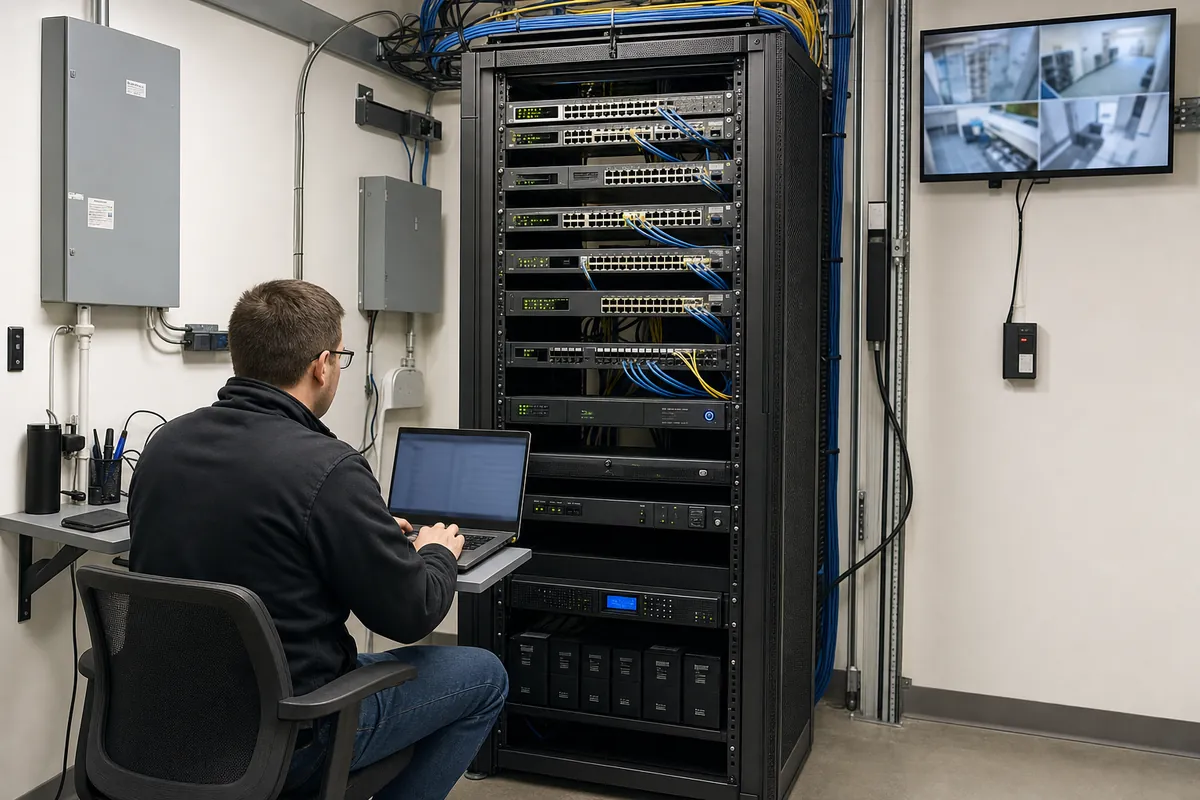
Each location needs a feasible cable route, network connection, power budget, weather protection and service path. Record cable distances, available pathways, penetrations, switch locations, PoE capacity, UPS coverage, cabinet space, environmental conditions and whether the network team must approve a new segment or firewall rule.
Interoperability must be specified feature by feature. ONVIF Profile T covers standardized capabilities including H.264/H.265 streaming, imaging settings, metadata, motion and tamper events, plus conditional capabilities such as HTTPS streaming and I/O support. Profile conformance does not mean every analytic, audio feature or vendor-specific function will behave identically in every recorder. Record the required capabilities and test the exact camera, firmware, recorder and client combination.
The survey should also identify bandwidth and storage inputs—resolution, frame rate, codec, expected scene activity, recording mode, retention period and redundancy—without pretending that a site visit alone produces a final storage number.
8. Produce a view schedule, not a camera count
The final schedule should contain one row per required view:
| Field | Required survey decision |
|---|---|
| View ID and location | Unique, durable name tied to the plan |
| Business purpose | Event or question the view supports |
| Subject and direction | Person, vehicle, asset or process and likely movement |
| Detail objective | Detection, observation, recognition, identification or process evidence |
| Target plane | Distance and scene width where the requirement applies |
| Operating conditions | Day, night, glare, weather, obstruction and occupancy assumptions |
| Privacy boundary | Exclusions, masking, notice and special review |
| Infrastructure | Mount, pathway, network, power, environment and access |
| Acceptance test | Observable pass/fail result using recorded footage |
This document allows bidders to price the same outcome and gives the owner a basis for rejecting a technically functioning but operationally inadequate view. It also supports a broader commercial security system plan in which cameras, access control, alarms, lighting and operating procedures are considered together.
9. Define acceptance tests before installation
For every critical view, write a test that a third party can repeat. Examples include:
- a person walks the expected route at normal speed in daytime and darkness;
- a vehicle occupies its normal position without blocking the evidentiary subject;
- an open dock door and vehicle headlights are introduced;
- recorded footage—not just live video—is exported and reviewed;
- timestamps are compared across related cameras and systems;
- the required detail is checked at the designated target plane;
- privacy masks and user permissions are verified; and
- loss of camera, link, storage or power produces the expected health alert.
Record the camera settings and test conditions. If a result fails, the remedy may be aim, focal length, lighting, bitrate, an additional choke-point view or a change to the physical process. The remedy should be based on the failed objective rather than an automatic upgrade to more megapixels.
A field-ready survey checklist
Before approving a camera design, confirm that the team can answer yes to each question:
- Is every planned view tied to a named event, risk or operational decision?
- Has the required level of detail been defined at a measurable target plane?
- Were obstructions, subject movement, daytime, darkness and glare considered?
- Are lens, field of view, depth of field and lighting assumptions documented?
- Are privacy boundaries and less intrusive alternatives recorded?
- Are network, power, storage and maintenance constraints visible in the scope?
- Are required interoperability features listed individually?
- Does every critical view have a recorded-video acceptance test?
- Can another qualified reviewer understand the design without relying on verbal promises?
That is the standard a useful survey should meet. A professional commercial security camera assessment should make the intended evidence, assumptions and trade-offs visible before hardware is purchased—not after an incident exposes the gap.
Frequently Asked Questions
Begin with incidents, operational questions and evidence requirements. Mark those objectives on a current floor plan, then determine the views needed to answer them. Selecting cameras first often produces broad coverage without useful detail at the critical moment.
Sometimes at a constrained choke point, but generally not across a large scene. A wider field of view spreads the available pixels across more area. Critical locations often need a contextual overview plus a tighter view at the point where useful detail can be captured.
Test them during representative conditions before final acceptance: daytime, darkness, glare, open dock doors, normal vehicle positions, seasonal obstructions and realistic subject movement. A still image from an empty site is not enough.
No. A profile identifies standardized capabilities, but optional features, firmware versions, analytics and vendor-specific functions still require testing with the exact camera, recorder and client combination.